
21
мар
Claire Bloom
Posted:admin| Look Back in Anger | |
|---|---|
| Directed by | Tony Richardson |
| Produced by | Harry Saltzman Gordon Scott |
| Written by | Nigel Kneale |
| Based on | Look Back in Anger by John Osborne |
| Starring | Richard Burton Claire Bloom Mary Ure Edith Evans |
| Music by | Chris Barber |
| Cinematography | Oswald Morris |
| Edited by | Richard Best |
Production companies | |
| Distributed by | Warner Bros. |
Release date | 15 September 1959[1] |
| 98 minutes | |
| Country | United Kingdom |
| Language | English |
| Budget | £250,000[2] |
| Box office | $1.1 million (est. US/ Canada rentals)[3] |
Age has not taken the flower off this Bloom. The well-known and respected stage, screen and television actress Claire Bloom, originally named Patricia Claire. Claire Bloom Celebrity Profile - Check out the latest Claire Bloom photo gallery, biography, pics, pictures, interviews, news, forums and blogs at Rotten.
Look Back in Anger is a 1959 British drama film starring Richard Burton, Claire Bloom and Mary Ure and directed by Tony Richardson. The film is based on John Osborne's play about a love triangle involving an intelligent but disaffected working class young man (Jimmy Porter), his upper-middle-class, impassive wife (Alison), and her haughty best friend (Helena Charles). Cliff, an amiable Welsh lodger, attempts to keep the peace. The character of Ma Tanner, only referred to in the play, is here brought to life by Edith Evans as a dramatic device to emphasise the class difference between Jimmy and Alison. The film and play are classic examples of the British cultural movement known as kitchen sink realism.
The vine begins to overcome all of the bubbles on the screen, forcing players to nip it at its base in order to stop it.Plans are also in the works to bring multiplayer to the game soon on Zynga.com.“We are learning from our players everyday,” says Turmell. The game also has some social elements built in, where players can ask for help from Facebook friends to complete certain tasks or get boosts in the game.The game launched with 65 levels, but has now grown to 77.“We're bringing new features and levels on a weekly basis,” says Turmell. Last night, for instance, a new growing vine hazard was added to the game. Bubble safari game.
Synopsis[edit]
Jimmy and Alison Porter, a young married couple, live in a Midlands industrial town (Derby) in a shabby attic flat, which they share with Jimmy’s best friend and business partner, Cliff. Despite graduating from university, Jimmy and Cliff make a meagre living running a sweet-stall in the local market. Jimmy’s inability to climb the socioeconomic ladder, coupled with other injustices he sees around him make him angry at society, particularly to those in authority. He takes out his frustrations on his wife Alison, a submissive girl from an upper-middle-class family. Jimmy's love for Alison is mixed with contempt, as he feels she never had to experience want, pain, or suffering. He verbally abuses her telling her, in temper, that he wishes she would have a child that would die. Unbeknownst to Jimmy, Alison is pregnant, and having mixed feelings about the pregnancy and her marriage.
Tensions heighten between the couple when Alison invites her assertive friend, Helena, whom Jimmy loathes, to temporarily stay with them. After witnessing Jimmy's treatment of Alison, Helena persuades Alison to leave Jimmy on the same day that Ma Tanner, who lent Jimmy the money to set up his stall, has a fatal stroke. Eventually, Alison moves out and departs with her kindly father, Colonel Redfern, who has come to collect her. A grieving Jimmy returns to the flat to find Alison gone, and learns for the first time that she is pregnant. He starts an emotional tirade with Helena, who first slaps him but then kisses him passionately, and the two begin an affair.
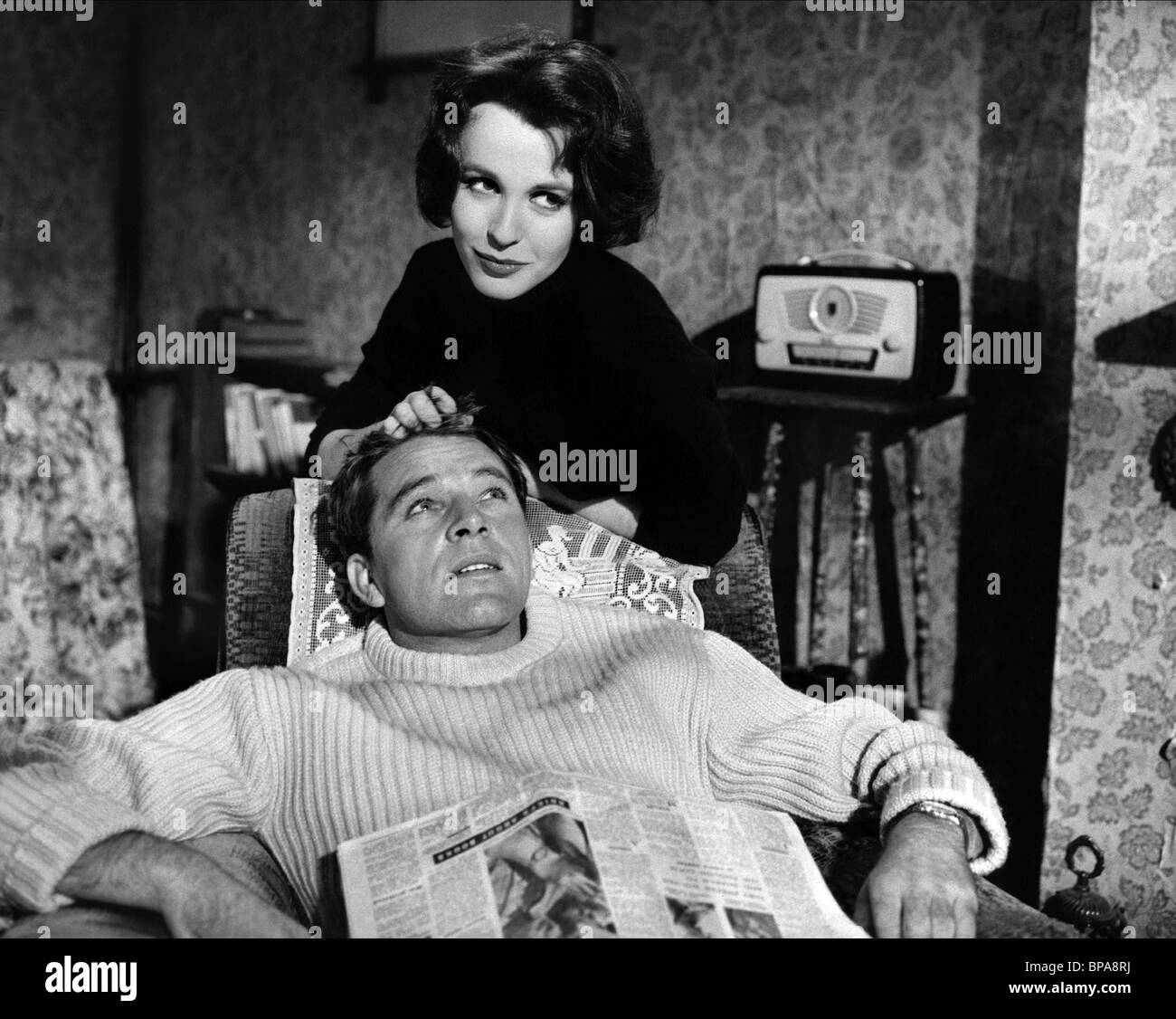
Months later, Jimmy and Helena have settled into a comfortable relationship, but Jimmy is still hurt at Alison’s departure. She, living in her parents' tranquil home, is having a precarious pregnancy, and fears that Jimmy's wish for her to suffer tragedy might come true. Cliff decides to strike out on his own, and Jimmy and Helena see him off at the train station. After Cliff's train departs, Jimmy and Helena see Alison sitting disconsolately in the station. Alison explains to Helena that she has lost the baby and Helena, realizing that she was wrong to break up their marriage, informs Jimmy that she is leaving him. Jimmy and Alison reconcile.
Cast[edit]
- Richard Burton as Jimmy Porter
- Claire Bloom as Helena Charles
- Mary Ure as Alison Porter
- Edith Evans as Ma Tanner
- Gary Raymond as Cliff Lewis
- Glen Byam Shaw as Colonel Redfern
- Phyllis Neilson-Terry as Mrs. Redfern
- Donald Pleasence as Hurst, the market inspector
- George Devine as Doctor
- Walter Hudd as Actor
- Nigel Davenport as 1st Commercial Traveller
- Alfred Lynch as 2nd Commercial Traveller
- Toke Townley as Spectacled Man
- S. P. Kapoor as Kapoor
Locations[edit]
Interiors were shot at Elstree Studios in September 1958. Some establishing shots were shot in Derby but the market scenes were shot in Deptford market; the railway station was Dalston Junction. Deptford and Dalston are in fact in the London area. The first market scenes were shot in the centre of Romford Market, Romford, Essex (now in the east London Borough of Havering).[4]
The scenes showing the street outside Jimmy and Alison Porter's flat were filmed in Harvist Road, London N7. The road was later demolished by Islington Borough Council and rebuilt as the Harvist Estate.[4]
Production[edit]
Look Back in Anger was produced by the Canadian impresario Harry Saltzman, who was seen an obvious choice since he was a fan of the play and it was he who urged Osborne and Richardson to set up Woodfall Film Productions. The film was to be Woodfall's first production.
Osborne insisted, against resistance from Saltzman, that Richardson was the right man to direct the film.[5] He had directed the original theatrical production but had no track record in feature films. The original backers, J. Arthur Rank, pulled out of the deal because of the choice of director.
Saltzman and Richardson persuaded Richard Burton to take on the title role, at a much lower fee than his accustomed Hollywood payoff. It is not known what Kenneth Haigh, who had created the role, thought of this. The idea of getting Nigel Kneale to extend the play into a screenplay is credited to the influential theatre critic Kenneth Tynan (who had been in large part responsible for the incredible success of the play). Osborne was relieved at not having to do the job and handed over story rights for a mere £2,000.[6]
The part of the doctor was specially created for George Devine, the artistic director of the English Stage Company and the man to whom Osborne most owed his success. Glen Byam Shaw, a long-time collaborator of Devine's (they created the Young Vic Company) was handed the role of Colonel Redfern. Two other members of the English Stage Company, Nigel Davenport and Alfred Lynch, were given small roles as commercial salesmen who try to pick up Alison and Helena in the railway station bar. The Chris Barber jazz band appears in the opening scenes set at a jazz club.
The free-to-play game will be available this summer.” Cartoon Network News“Exclusive soft launch access in Australia, New Zealand, Philippines, and Singapore!The bloons have invaded the land of Ooo and it's up to Finn, Jake and the monkeys to stop them! Players can recruit their favorite Adventure Time characters including Princess Bubblegum, Marceline, Ice King and more, as well as the monkeys from the Bloons TD franchise as they travel from kingdom to kingdom to send the Bloons packing. 18 Heroes (3 IAPs), 55 Allies and 31 Powers “Developed by Ninja Kiwi and based on their Bloons Tower Defense franchise, Bloons Adventure Time TD features the Bloon hordes invading the Land of Ooo! Zombie farm battles wikipedia. Finn and Jake will need all the help they can get to stop them.
Reception[edit]
The film was not at first successful. Westminster Council gave it an X certificate, and it opened on 29 May 1959 during one of London's rare heatwaves.[7] Tim Adler wrote that Richardson never found out whether or not the film made a profit.[8] Burton was widely felt to be too old and mature-looking for the young character he played.
The film was nominated in 4 categories in the 1959 BAFTA Awards: Best British Actor (Richard Burton); Best British Film; Best British Screenplay (Nigel Kneale); and Best Film from any Source. However, it won in none of them, the winners being respectively Peter Sellers (I'm All Right Jack); Sapphire; Frank Harvey, John Boulting and Alan Hackney for I'm All Right Jack; and Ben-Hur.
Burton was also nominated as Best Motion Picture Actor – Drama in the 1959 Golden Globes, but the award went to Anthony Franciosa in Career.
DVD version[edit]
The DVD was released in 2001 in its original aspect ratio of 1.66:1.

Sources[edit]
- Osborne, John (1991). Almost a Gentleman. London: Faber & Faber. ISBN0-571-16635-0.
- Adler, Tim (2012). The House of Redgrave. London: Aurum. ISBN978-1-84513-623-9.
- Richardson, Tony (1993). Long Distance Runner – A memoir. London: Faber & Faber. ISBN0-571-16852-3.
Footnotes[edit]
- ^'Overview'. TCM. Retrieved 23 April 2016.
- ^Alexander Walker, Hollywood, England, Stein and Day, 1974 p59
- ^'1959: Probable Domestic Take', Variety, 6 January 1960 p 34
- ^ ab'Look Back in Anger'. ReelStreets. Retrieved 20 November 2019.
- ^He wrote 'This was based not on blind loyalty but on my untutored faith in his flair and his being the only possible commander to lead Woodfall's opening assault on the suburban vapidity of British film-making'. (Osborne, p. 107)
- ^Osborne, p. 108.
- ^Richardson 1993.
- ^Adler, p.70
External links[edit]
- Look Back in Anger on IMDb
Popular Posts
Look Back in Anger Directed by Tony Richardson Produced by Harry Saltzman
Gordon ScottWritten by Nigel Kneale Based on Look Back in Anger
by John OsborneStarring Richard Burton
Claire Bloom
Mary Ure
Edith EvansMusic by Chris Barber Cinematography Oswald Morris Edited by Richard Best Production
companiesDistributed by Warner Bros. Release date15 September 1959[1] 98 minutes Country United Kingdom Language English Budget £250,000[2] Box office $1.1 million (est. US/ Canada rentals)[3] Age has not taken the flower off this Bloom. The well-known and respected stage, screen and television actress Claire Bloom, originally named Patricia Claire. Claire Bloom Celebrity Profile - Check out the latest Claire Bloom photo gallery, biography, pics, pictures, interviews, news, forums and blogs at Rotten.
Look Back in Anger is a 1959 British drama film starring Richard Burton, Claire Bloom and Mary Ure and directed by Tony Richardson. The film is based on John Osborne\'s play about a love triangle involving an intelligent but disaffected working class young man (Jimmy Porter), his upper-middle-class, impassive wife (Alison), and her haughty best friend (Helena Charles). Cliff, an amiable Welsh lodger, attempts to keep the peace. The character of Ma Tanner, only referred to in the play, is here brought to life by Edith Evans as a dramatic device to emphasise the class difference between Jimmy and Alison. The film and play are classic examples of the British cultural movement known as kitchen sink realism.
The vine begins to overcome all of the bubbles on the screen, forcing players to nip it at its base in order to stop it.Plans are also in the works to bring multiplayer to the game soon on Zynga.com.“We are learning from our players everyday,” says Turmell. The game also has some social elements built in, where players can ask for help from Facebook friends to complete certain tasks or get boosts in the game.The game launched with 65 levels, but has now grown to 77.“We\'re bringing new features and levels on a weekly basis,” says Turmell. Last night, for instance, a new growing vine hazard was added to the game. Bubble safari game.
Synopsis[edit]
Jimmy and Alison Porter, a young married couple, live in a Midlands industrial town (Derby) in a shabby attic flat, which they share with Jimmy’s best friend and business partner, Cliff. Despite graduating from university, Jimmy and Cliff make a meagre living running a sweet-stall in the local market. Jimmy’s inability to climb the socioeconomic ladder, coupled with other injustices he sees around him make him angry at society, particularly to those in authority. He takes out his frustrations on his wife Alison, a submissive girl from an upper-middle-class family. Jimmy\'s love for Alison is mixed with contempt, as he feels she never had to experience want, pain, or suffering. He verbally abuses her telling her, in temper, that he wishes she would have a child that would die. Unbeknownst to Jimmy, Alison is pregnant, and having mixed feelings about the pregnancy and her marriage.
Tensions heighten between the couple when Alison invites her assertive friend, Helena, whom Jimmy loathes, to temporarily stay with them. After witnessing Jimmy\'s treatment of Alison, Helena persuades Alison to leave Jimmy on the same day that Ma Tanner, who lent Jimmy the money to set up his stall, has a fatal stroke. Eventually, Alison moves out and departs with her kindly father, Colonel Redfern, who has come to collect her. A grieving Jimmy returns to the flat to find Alison gone, and learns for the first time that she is pregnant. He starts an emotional tirade with Helena, who first slaps him but then kisses him passionately, and the two begin an affair.

Months later, Jimmy and Helena have settled into a comfortable relationship, but Jimmy is still hurt at Alison’s departure. She, living in her parents\' tranquil home, is having a precarious pregnancy, and fears that Jimmy\'s wish for her to suffer tragedy might come true. Cliff decides to strike out on his own, and Jimmy and Helena see him off at the train station. After Cliff\'s train departs, Jimmy and Helena see Alison sitting disconsolately in the station. Alison explains to Helena that she has lost the baby and Helena, realizing that she was wrong to break up their marriage, informs Jimmy that she is leaving him. Jimmy and Alison reconcile.
Cast[edit]
- Richard Burton as Jimmy Porter
- Claire Bloom as Helena Charles
- Mary Ure as Alison Porter
- Edith Evans as Ma Tanner
- Gary Raymond as Cliff Lewis
- Glen Byam Shaw as Colonel Redfern
- Phyllis Neilson-Terry as Mrs. Redfern
- Donald Pleasence as Hurst, the market inspector
- George Devine as Doctor
- Walter Hudd as Actor
- Nigel Davenport as 1st Commercial Traveller
- Alfred Lynch as 2nd Commercial Traveller
- Toke Townley as Spectacled Man
- S. P. Kapoor as Kapoor
Locations[edit]
Interiors were shot at Elstree Studios in September 1958. Some establishing shots were shot in Derby but the market scenes were shot in Deptford market; the railway station was Dalston Junction. Deptford and Dalston are in fact in the London area. The first market scenes were shot in the centre of Romford Market, Romford, Essex (now in the east London Borough of Havering).[4]
The scenes showing the street outside Jimmy and Alison Porter\'s flat were filmed in Harvist Road, London N7. The road was later demolished by Islington Borough Council and rebuilt as the Harvist Estate.[4]
Production[edit]
Look Back in Anger was produced by the Canadian impresario Harry Saltzman, who was seen an obvious choice since he was a fan of the play and it was he who urged Osborne and Richardson to set up Woodfall Film Productions. The film was to be Woodfall\'s first production.
Osborne insisted, against resistance from Saltzman, that Richardson was the right man to direct the film.[5] He had directed the original theatrical production but had no track record in feature films. The original backers, J. Arthur Rank, pulled out of the deal because of the choice of director.
Saltzman and Richardson persuaded Richard Burton to take on the title role, at a much lower fee than his accustomed Hollywood payoff. It is not known what Kenneth Haigh, who had created the role, thought of this. The idea of getting Nigel Kneale to extend the play into a screenplay is credited to the influential theatre critic Kenneth Tynan (who had been in large part responsible for the incredible success of the play). Osborne was relieved at not having to do the job and handed over story rights for a mere £2,000.[6]
The part of the doctor was specially created for George Devine, the artistic director of the English Stage Company and the man to whom Osborne most owed his success. Glen Byam Shaw, a long-time collaborator of Devine\'s (they created the Young Vic Company) was handed the role of Colonel Redfern. Two other members of the English Stage Company, Nigel Davenport and Alfred Lynch, were given small roles as commercial salesmen who try to pick up Alison and Helena in the railway station bar. The Chris Barber jazz band appears in the opening scenes set at a jazz club.
The free-to-play game will be available this summer.” Cartoon Network News“Exclusive soft launch access in Australia, New Zealand, Philippines, and Singapore!The bloons have invaded the land of Ooo and it\'s up to Finn, Jake and the monkeys to stop them! Players can recruit their favorite Adventure Time characters including Princess Bubblegum, Marceline, Ice King and more, as well as the monkeys from the Bloons TD franchise as they travel from kingdom to kingdom to send the Bloons packing. 18 Heroes (3 IAPs), 55 Allies and 31 Powers “Developed by Ninja Kiwi and based on their Bloons Tower Defense franchise, Bloons Adventure Time TD features the Bloon hordes invading the Land of Ooo! Zombie farm battles wikipedia. Finn and Jake will need all the help they can get to stop them.
Reception[edit]
The film was not at first successful. Westminster Council gave it an X certificate, and it opened on 29 May 1959 during one of London\'s rare heatwaves.[7] Tim Adler wrote that Richardson never found out whether or not the film made a profit.[8] Burton was widely felt to be too old and mature-looking for the young character he played.
The film was nominated in 4 categories in the 1959 BAFTA Awards: Best British Actor (Richard Burton); Best British Film; Best British Screenplay (Nigel Kneale); and Best Film from any Source. However, it won in none of them, the winners being respectively Peter Sellers (I\'m All Right Jack); Sapphire; Frank Harvey, John Boulting and Alan Hackney for I\'m All Right Jack; and Ben-Hur.
Burton was also nominated as Best Motion Picture Actor – Drama in the 1959 Golden Globes, but the award went to Anthony Franciosa in Career.
DVD version[edit]
The DVD was released in 2001 in its original aspect ratio of 1.66:1.

Sources[edit]
- Osborne, John (1991). Almost a Gentleman. London: Faber & Faber. ISBN0-571-16635-0.
- Adler, Tim (2012). The House of Redgrave. London: Aurum. ISBN978-1-84513-623-9.
- Richardson, Tony (1993). Long Distance Runner – A memoir. London: Faber & Faber. ISBN0-571-16852-3.
Footnotes[edit]
- ^\'Overview\'. TCM. Retrieved 23 April 2016.
- ^Alexander Walker, Hollywood, England, Stein and Day, 1974 p59
- ^\'1959: Probable Domestic Take\', Variety, 6 January 1960 p 34
- ^ ab\'Look Back in Anger\'. ReelStreets. Retrieved 20 November 2019.
- ^He wrote \'This was based not on blind loyalty but on my untutored faith in his flair and his being the only possible commander to lead Woodfall\'s opening assault on the suburban vapidity of British film-making\'. (Osborne, p. 107)
- ^Osborne, p. 108.
- ^Richardson 1993.
- ^Adler, p.70
External links[edit]
- Look Back in Anger on IMDb
Retrieved from \'https://en.wikipedia.org/w/index.php?title=Look_Back_in_Anger_(1959_film)&oldid=950321704\'...'>Claire Bloom(21.03.2020)Look Back in Anger Directed by Tony Richardson Produced by Harry Saltzman
Gordon ScottWritten by Nigel Kneale Based on Look Back in Anger
by John OsborneStarring Richard Burton
Claire Bloom
Mary Ure
Edith EvansMusic by Chris Barber Cinematography Oswald Morris Edited by Richard Best Production
companiesDistributed by Warner Bros. Release date15 September 1959[1] 98 minutes Country United Kingdom Language English Budget £250,000[2] Box office $1.1 million (est. US/ Canada rentals)[3] Age has not taken the flower off this Bloom. The well-known and respected stage, screen and television actress Claire Bloom, originally named Patricia Claire. Claire Bloom Celebrity Profile - Check out the latest Claire Bloom photo gallery, biography, pics, pictures, interviews, news, forums and blogs at Rotten.
Look Back in Anger is a 1959 British drama film starring Richard Burton, Claire Bloom and Mary Ure and directed by Tony Richardson. The film is based on John Osborne\'s play about a love triangle involving an intelligent but disaffected working class young man (Jimmy Porter), his upper-middle-class, impassive wife (Alison), and her haughty best friend (Helena Charles). Cliff, an amiable Welsh lodger, attempts to keep the peace. The character of Ma Tanner, only referred to in the play, is here brought to life by Edith Evans as a dramatic device to emphasise the class difference between Jimmy and Alison. The film and play are classic examples of the British cultural movement known as kitchen sink realism.
The vine begins to overcome all of the bubbles on the screen, forcing players to nip it at its base in order to stop it.Plans are also in the works to bring multiplayer to the game soon on Zynga.com.“We are learning from our players everyday,” says Turmell. The game also has some social elements built in, where players can ask for help from Facebook friends to complete certain tasks or get boosts in the game.The game launched with 65 levels, but has now grown to 77.“We\'re bringing new features and levels on a weekly basis,” says Turmell. Last night, for instance, a new growing vine hazard was added to the game. Bubble safari game.
Synopsis[edit]
Jimmy and Alison Porter, a young married couple, live in a Midlands industrial town (Derby) in a shabby attic flat, which they share with Jimmy’s best friend and business partner, Cliff. Despite graduating from university, Jimmy and Cliff make a meagre living running a sweet-stall in the local market. Jimmy’s inability to climb the socioeconomic ladder, coupled with other injustices he sees around him make him angry at society, particularly to those in authority. He takes out his frustrations on his wife Alison, a submissive girl from an upper-middle-class family. Jimmy\'s love for Alison is mixed with contempt, as he feels she never had to experience want, pain, or suffering. He verbally abuses her telling her, in temper, that he wishes she would have a child that would die. Unbeknownst to Jimmy, Alison is pregnant, and having mixed feelings about the pregnancy and her marriage.
Tensions heighten between the couple when Alison invites her assertive friend, Helena, whom Jimmy loathes, to temporarily stay with them. After witnessing Jimmy\'s treatment of Alison, Helena persuades Alison to leave Jimmy on the same day that Ma Tanner, who lent Jimmy the money to set up his stall, has a fatal stroke. Eventually, Alison moves out and departs with her kindly father, Colonel Redfern, who has come to collect her. A grieving Jimmy returns to the flat to find Alison gone, and learns for the first time that she is pregnant. He starts an emotional tirade with Helena, who first slaps him but then kisses him passionately, and the two begin an affair.
Months later, Jimmy and Helena have settled into a comfortable relationship, but Jimmy is still hurt at Alison’s departure. She, living in her parents\' tranquil home, is having a precarious pregnancy, and fears that Jimmy\'s wish for her to suffer tragedy might come true. Cliff decides to strike out on his own, and Jimmy and Helena see him off at the train station. After Cliff\'s train departs, Jimmy and Helena see Alison sitting disconsolately in the station. Alison explains to Helena that she has lost the baby and Helena, realizing that she was wrong to break up their marriage, informs Jimmy that she is leaving him. Jimmy and Alison reconcile.
Cast[edit]
- Richard Burton as Jimmy Porter
- Claire Bloom as Helena Charles
- Mary Ure as Alison Porter
- Edith Evans as Ma Tanner
- Gary Raymond as Cliff Lewis
- Glen Byam Shaw as Colonel Redfern
- Phyllis Neilson-Terry as Mrs. Redfern
- Donald Pleasence as Hurst, the market inspector
- George Devine as Doctor
- Walter Hudd as Actor
- Nigel Davenport as 1st Commercial Traveller
- Alfred Lynch as 2nd Commercial Traveller
- Toke Townley as Spectacled Man
- S. P. Kapoor as Kapoor
Locations[edit]
Interiors were shot at Elstree Studios in September 1958. Some establishing shots were shot in Derby but the market scenes were shot in Deptford market; the railway station was Dalston Junction. Deptford and Dalston are in fact in the London area. The first market scenes were shot in the centre of Romford Market, Romford, Essex (now in the east London Borough of Havering).[4]
The scenes showing the street outside Jimmy and Alison Porter\'s flat were filmed in Harvist Road, London N7. The road was later demolished by Islington Borough Council and rebuilt as the Harvist Estate.[4]
Production[edit]
Look Back in Anger was produced by the Canadian impresario Harry Saltzman, who was seen an obvious choice since he was a fan of the play and it was he who urged Osborne and Richardson to set up Woodfall Film Productions. The film was to be Woodfall\'s first production.
Osborne insisted, against resistance from Saltzman, that Richardson was the right man to direct the film.[5] He had directed the original theatrical production but had no track record in feature films. The original backers, J. Arthur Rank, pulled out of the deal because of the choice of director.
Saltzman and Richardson persuaded Richard Burton to take on the title role, at a much lower fee than his accustomed Hollywood payoff. It is not known what Kenneth Haigh, who had created the role, thought of this. The idea of getting Nigel Kneale to extend the play into a screenplay is credited to the influential theatre critic Kenneth Tynan (who had been in large part responsible for the incredible success of the play). Osborne was relieved at not having to do the job and handed over story rights for a mere £2,000.[6]
The part of the doctor was specially created for George Devine, the artistic director of the English Stage Company and the man to whom Osborne most owed his success. Glen Byam Shaw, a long-time collaborator of Devine\'s (they created the Young Vic Company) was handed the role of Colonel Redfern. Two other members of the English Stage Company, Nigel Davenport and Alfred Lynch, were given small roles as commercial salesmen who try to pick up Alison and Helena in the railway station bar. The Chris Barber jazz band appears in the opening scenes set at a jazz club.
The free-to-play game will be available this summer.” Cartoon Network News“Exclusive soft launch access in Australia, New Zealand, Philippines, and Singapore!The bloons have invaded the land of Ooo and it\'s up to Finn, Jake and the monkeys to stop them! Players can recruit their favorite Adventure Time characters including Princess Bubblegum, Marceline, Ice King and more, as well as the monkeys from the Bloons TD franchise as they travel from kingdom to kingdom to send the Bloons packing. 18 Heroes (3 IAPs), 55 Allies and 31 Powers “Developed by Ninja Kiwi and based on their Bloons Tower Defense franchise, Bloons Adventure Time TD features the Bloon hordes invading the Land of Ooo! Zombie farm battles wikipedia. Finn and Jake will need all the help they can get to stop them.
Reception[edit]
The film was not at first successful. Westminster Council gave it an X certificate, and it opened on 29 May 1959 during one of London\'s rare heatwaves.[7] Tim Adler wrote that Richardson never found out whether or not the film made a profit.[8] Burton was widely felt to be too old and mature-looking for the young character he played.
The film was nominated in 4 categories in the 1959 BAFTA Awards: Best British Actor (Richard Burton); Best British Film; Best British Screenplay (Nigel Kneale); and Best Film from any Source. However, it won in none of them, the winners being respectively Peter Sellers (I\'m All Right Jack); Sapphire; Frank Harvey, John Boulting and Alan Hackney for I\'m All Right Jack; and Ben-Hur.
Burton was also nominated as Best Motion Picture Actor – Drama in the 1959 Golden Globes, but the award went to Anthony Franciosa in Career.
DVD version[edit]
The DVD was released in 2001 in its original aspect ratio of 1.66:1.
Sources[edit]
- Osborne, John (1991). Almost a Gentleman. London: Faber & Faber. ISBN0-571-16635-0.
- Adler, Tim (2012). The House of Redgrave. London: Aurum. ISBN978-1-84513-623-9.
- Richardson, Tony (1993). Long Distance Runner – A memoir. London: Faber & Faber. ISBN0-571-16852-3.
Footnotes[edit]
- ^\'Overview\'. TCM. Retrieved 23 April 2016.
- ^Alexander Walker, Hollywood, England, Stein and Day, 1974 p59
- ^\'1959: Probable Domestic Take\', Variety, 6 January 1960 p 34
- ^ ab\'Look Back in Anger\'. ReelStreets. Retrieved 20 November 2019.
- ^He wrote \'This was based not on blind loyalty but on my untutored faith in his flair and his being the only possible commander to lead Woodfall\'s opening assault on the suburban vapidity of British film-making\'. (Osborne, p. 107)
- ^Osborne, p. 108.
- ^Richardson 1993.
- ^Adler, p.70
External links[edit]
- Look Back in Anger on IMDb
Retrieved from \'https://en.wikipedia.org/w/index.php?title=Look_Back_in_Anger_(1959_film)&oldid=950321704\'...'>Claire Bloom(21.03.2020)