
21
апр
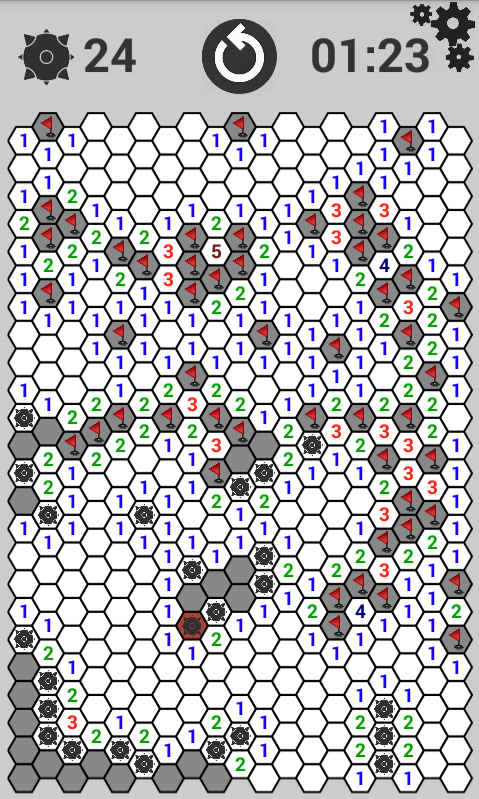
A puzzle game, based on Minesweeper idea. It introduces hexagonal grid, 3 different mine powers and extended neighborhood information. All the above allows to present non trivial but mostly solvable game situations even for most experienced player.
Hexagon:Defeat your opponent by having more diamonds at the end of the game in this fun and challenging arcade game. You can play against the computer or with a friend. Start thinking of strategies of how to defeat your opponent when moving your diamonds. Play smart and strategically!How to Play: Select if you are going to play against the computer or with a friend. To start the game, left click on a diamond and on the place on the hexagon that you want to move it to, using your computer mouse. When you select a diamond, you are shown the possible options of where it can jump to. By moving to a place adjacent to it, it will multiply itself. By moving it further away, it will jump there and reverse to the opposite color diamond to yours. Conquer as many opposite colored diamonds, so that they become your color.
If this Flash-based game no longer works on IE11 on your PC / MAC, try playing on Chrome or Firefox browser.
Strikeforce Heroes 2
Ping Pong
1010 Deluxe
Ourworld
Minesweeper is a single-playerpuzzlevideo game. The objective of the game is to clear a rectangular board containing hidden 'mines' or bombs without detonating any of them, with help from clues about the number of neighboring mines in each field. The game originates from the 1960s, and has been written for many computing platforms in use today. It has many variations and offshoots.
Some versions of Minesweeper will set up the board by never placing a mine on the first square revealed.[1]Minesweeper for versions of Windows protects the first square revealed; from Windows 7 onward, players may elect to replay a board, in which the game is played by revealing squares of the grid by clicking or otherwise indicating each square. If a square containing a mine is revealed, the player loses the game. If no mine is revealed, a digit is instead displayed in the square, indicating how many adjacent squares contain mines; if no mines are adjacent, the square becomes blank, and all adjacent squares will be recursively revealed. The player uses this information to deduce the contents of other squares, and may either safely reveal each square or mark the square as containing a mine.
Gameplay[edit]
Minesweeper has a very basic gameplay style. In its original form, mines are scattered throughout a board. This board is divided into cells, which have three states: uncovered, covered and flagged. A covered cell is blank and clickable, while an uncovered cell is exposed, either containing a number (the mines adjacent to it), or a mine. When a cell is uncovered by a player click, and if it bears a mine, the game ends. A flagged cell is similar to a covered one, in the way that mines are not triggered when a cell is flagged, and it is impossible to lose through the action of flagging a cell. However, flagging a cell implies that a player thinks there is a mine underneath, which causes the game to deduct an available mine from the display.
In order to win the game, players must logically deduce where mines exist through the use of the numbers given by uncovered cells. To win, all non-mine cells must be uncovered and all mine cells must be flagged. At this stage, the timer is stopped.
When a player left-clicks on a cell, the game will uncover it. If there are no mines adjacent to that particular cell, the mine will display a blank tile or a '0', and all adjacent cells will automatically be uncovered. Right-clicking on a cell will flag it, causing a flag to appear on it. Note that flagged cells are still covered, and a player can click on it to uncover it, like a normal covered cell.
History[edit]
Minesweeper has its origins in the earliest mainframe games of the 1960s and 1970s. The earliest ancestor of Minesweeper was Jerimac Ratliff's Cube. The basic gameplay style became a popular segment of the puzzle video game genre during the 1980s, with such titles as Mined-Out (Quicksilva, 1983), Yomp (Virgin Interactive, 1983), and Cube. Cube was succeeded by Relentless Logic (or RLogic for short), by Conway, Hong, and Smith, available for MS-DOS as early as 1985; the player took the role of a private in the United States Marine Corps, delivering an important message to the U.S. Command Center. RLogic had greater similarity to Minesweeper than to Cube in concept, but a number of differences exist:
- In RLogic, the player must navigate through the minefield, from the top left right angled corner to the bottom right angled corner (the Command Center).
- It is not necessary to clear all non-mine squares. Also, there is no mechanism for marking mines or counting the number of mines found.
- The number of steps taken is counted. Although no high score functionality is included, players could attempt to beat their personal best score for a given number of mines.
- Unlike Minesweeper, the size of the minefield is fixed. However, the player may still specify the number of mines.
- Because the player must navigate through the minefield, it is sometimes impossible to win — namely, when the mines block all possible paths.
The gameplay mechanics of Minesweeper are included in a variety of other software titles, including:
- The mini-game Vinesweeper implemented into the MMORPGRuneScape; in this iteration (written by Jagex developer Danny J), the Minesweeper gameplay is given a large multiplayer aspect and the 'game board' adopts a continually resetting timer. This allows for a never-ending game of Minesweeper where the skill is assessed in points rather than 'game completion'.
- The PC game Mole Control (developed by Remode); in this game, the Minesweeper mechanic is integrated into a puzzle adventure game based in a village called Molar Creek, which has been overrun with exploding moles. The player acts as the local inventor's assistant, who is tasked with clearing the village of exploding moles. A time attack mode, called the Molar Creek Annual Mole Control competition, is also available.
Distribution and variants[edit]
Versions of Minesweeper are frequently bundled with operating systems and GUIs, including Minesweeper for OS/2, Minesweeper in Windows, KMines in KDE (Unix-like OSes), GNOME Mines in GNOME and MineHunt in Palm OS. Many clones can be found on the Internet. Ncaa march madness 2005 cheat codes.
Variants of the basic game generally have differently shaped minefields, in either two or three dimensions, and may have more than one mine per cell. For example, X11-based XBomb adds triangular and hexagonal grids, and Professional Minesweeper for Windows includes these and others. There are also variants for more than one player, in which the players compete against each other.
The HP-48Ggraphing calculator includes a variation on the theme called 'Minehunt', where the player has to move safely from one corner of the playfield to the other. The only clues given are how many mines are in the squares surrounding the player's current position.
The Voltorb Flip game in the non-Japanese releases of Pokémon HeartGold and SoulSilver is a variation of Minesweeper and Picross.[2]
A logic puzzle variant of minesweeper, suitable for playing on paper, starts with some squares already revealed. The player cannot reveal any more squares, but must instead mark the remaining mines correctly. Unlike the usual form of minesweeper, these puzzles usually have a unique solution.[3] These puzzles appeared under the name 'tentaizu' (天体図), Japanese for a star map, in Southwest Airlines' magazine Spirit in 2008–2009.[citation needed]
In the game Minecraft, the 2015 April Fool's update 'The Love and Hugs Update' added 'Minescreeper'. It is a near exact copy of Minesweeper, except, instead of avoiding the mines, the player must avoid hidden Creepers.[citation needed]
Online, non-rectangular
3D
Hexagonal
Triangular
Multiple mines in cells Lego creator car.
Computational complexity[edit]
In 2000, Richard Kaye published a proof that it is NP-complete to determine whether a given grid of uncovered, correctly flagged, and unknown squares, the labels of the foremost also given, has an arrangement of mines for which it is possible within the rules of the game. The argument is constructive, a method to quickly convert any Boolean circuit into such a grid that is possible if and only if the circuit is satisfiable; membership in NP is established by using the arrangement of mines as a certificate.[4] If, however, a minesweeper board is already guaranteed to be consistent, solving it is not known to be NP-complete, but it has been proven to be co-NP-complete.[5]
Kaye also proved that infinite Minesweeper is Turing-complete.[6]
Rules[edit]
The first click will never be a mine.[7] It will clear the map and place numbers on the grid. The numbers reflect the number of mines touching a square.[7]
See also[edit]
Notes[edit]
- ^'Mines'. www.chiark.greenend.org.uk. Retrieved 28 March 2017.
- ^Scullion, Chris (3 February 2010). 'News: Pokémon HeartGold/SoulSilver mini-game revealed! - Official Nintendo Magazine'. officialnintendomagazine.co.uk. Archived from the original on 6 February 2010. Retrieved 13 January 2020.
- ^Minesweeper Puzzle Magazine, accessed 2017-02-07.
- ^Kaye (2000).
- ^Allan Scott, Ulrike Stege, Iris van Rooij, Minesweeper may not be NP-complete but is hard nonetheless, The Mathematical Intelligencer33:4 (2011), pp. 5–17.
- ^Kaye, Richard (31 May 2007). 'Infinite versions of minesweeper are Turing complete'(PDF). Archived from the original(PDF) on 3 August 2016. Retrieved 8 July 2016.
- ^ ab'How to Play Minesweeper'. wikiHow. Retrieved 9 February 2020.
References[edit]
- Adamatzky, Andrew (1997). 'How cellular automaton plays Minesweeper'. Applied Mathematics and Computation. 85 (2–3): 127–137. doi:10.1016/S0096-3003(96)00117-8.
- Lakshtanov, Evgeny; Oleg German (2010). ''Minesweeper' and spectrum of discrete Laplacians'. Applicable Analysis. 89 (12): 1907–1916. arXiv:0806.3480. doi:10.1080/00036811.2010.505189.
- Kaye, Richard (2000). 'Minesweeper is NP-complete'. Mathematical Intelligencer. 22 (2): 9–15. doi:10.1007/BF03025367. — Further information available online at Richard Kaye's Minesweeper pages.
- Mordechai Ben-Ari (2018). Minesweeper is NP-Complete(PDF) (Report). Weizmann Institute of Science, Department of Science Teaching. — An open-access paper explaining Kaye's NP-completeness result.
Popular Posts
A puzzle game, based on Minesweeper idea. It introduces hexagonal grid, 3 different mine powers and extended neighborhood information. All the above allows to present non trivial but mostly solvable game situations even for most experienced player.
Hexagon:Defeat your opponent by having more diamonds at the end of the game in this fun and challenging arcade game. You can play against the computer or with a friend. Start thinking of strategies of how to defeat your opponent when moving your diamonds. Play smart and strategically!How to Play: Select if you are going to play against the computer or with a friend. To start the game, left click on a diamond and on the place on the hexagon that you want to move it to, using your computer mouse. When you select a diamond, you are shown the possible options of where it can jump to. By moving to a place adjacent to it, it will multiply itself. By moving it further away, it will jump there and reverse to the opposite color diamond to yours. Conquer as many opposite colored diamonds, so that they become your color.
If this Flash-based game no longer works on IE11 on your PC / MAC, try playing on Chrome or Firefox browser.
Due to new European Union General Data Protection Regulation (GDPR) requirements for websites & browser cookies, we are unfortunately unable to load this game file in EEA countries at this time because of the additional maintenance cost & loss of ad-related income from EEA countries needed to support game sites & developers. Thank you for visiting our games site.Some helpful links to share include Top 100 Games, Top New Games & Latest Games. Enjoy!Hexagon players also like to play these games on Learn4Good:
Strikeforce Heroes 2
Ping Pong
1010 Deluxe
OurworldThe commonly found theme for MinesweeperMinesweeper is a single-playerpuzzlevideo game. The objective of the game is to clear a rectangular board containing hidden \'mines\' or bombs without detonating any of them, with help from clues about the number of neighboring mines in each field. The game originates from the 1960s, and has been written for many computing platforms in use today. It has many variations and offshoots.
Some versions of Minesweeper will set up the board by never placing a mine on the first square revealed.[1]Minesweeper for versions of Windows protects the first square revealed; from Windows 7 onward, players may elect to replay a board, in which the game is played by revealing squares of the grid by clicking or otherwise indicating each square. If a square containing a mine is revealed, the player loses the game. If no mine is revealed, a digit is instead displayed in the square, indicating how many adjacent squares contain mines; if no mines are adjacent, the square becomes blank, and all adjacent squares will be recursively revealed. The player uses this information to deduce the contents of other squares, and may either safely reveal each square or mark the square as containing a mine.
Gameplay[edit]
Minesweeper has a very basic gameplay style. In its original form, mines are scattered throughout a board. This board is divided into cells, which have three states: uncovered, covered and flagged. A covered cell is blank and clickable, while an uncovered cell is exposed, either containing a number (the mines adjacent to it), or a mine. When a cell is uncovered by a player click, and if it bears a mine, the game ends. A flagged cell is similar to a covered one, in the way that mines are not triggered when a cell is flagged, and it is impossible to lose through the action of flagging a cell. However, flagging a cell implies that a player thinks there is a mine underneath, which causes the game to deduct an available mine from the display.
In order to win the game, players must logically deduce where mines exist through the use of the numbers given by uncovered cells. To win, all non-mine cells must be uncovered and all mine cells must be flagged. At this stage, the timer is stopped.
When a player left-clicks on a cell, the game will uncover it. If there are no mines adjacent to that particular cell, the mine will display a blank tile or a \'0', and all adjacent cells will automatically be uncovered. Right-clicking on a cell will flag it, causing a flag to appear on it. Note that flagged cells are still covered, and a player can click on it to uncover it, like a normal covered cell.
History[edit]
Minesweeper has its origins in the earliest mainframe games of the 1960s and 1970s. The earliest ancestor of Minesweeper was Jerimac Ratliff\'s Cube. The basic gameplay style became a popular segment of the puzzle video game genre during the 1980s, with such titles as Mined-Out (Quicksilva, 1983), Yomp (Virgin Interactive, 1983), and Cube. Cube was succeeded by Relentless Logic (or RLogic for short), by Conway, Hong, and Smith, available for MS-DOS as early as 1985; the player took the role of a private in the United States Marine Corps, delivering an important message to the U.S. Command Center. RLogic had greater similarity to Minesweeper than to Cube in concept, but a number of differences exist:
- In RLogic, the player must navigate through the minefield, from the top left right angled corner to the bottom right angled corner (the Command Center).
- It is not necessary to clear all non-mine squares. Also, there is no mechanism for marking mines or counting the number of mines found.
- The number of steps taken is counted. Although no high score functionality is included, players could attempt to beat their personal best score for a given number of mines.
- Unlike Minesweeper, the size of the minefield is fixed. However, the player may still specify the number of mines.
- Because the player must navigate through the minefield, it is sometimes impossible to win — namely, when the mines block all possible paths.
The gameplay mechanics of Minesweeper are included in a variety of other software titles, including:
- The mini-game Vinesweeper implemented into the MMORPGRuneScape; in this iteration (written by Jagex developer Danny J), the Minesweeper gameplay is given a large multiplayer aspect and the \'game board\' adopts a continually resetting timer. This allows for a never-ending game of Minesweeper where the skill is assessed in points rather than \'game completion\'.
- The PC game Mole Control (developed by Remode); in this game, the Minesweeper mechanic is integrated into a puzzle adventure game based in a village called Molar Creek, which has been overrun with exploding moles. The player acts as the local inventor\'s assistant, who is tasked with clearing the village of exploding moles. A time attack mode, called the Molar Creek Annual Mole Control competition, is also available.
Distribution and variants[edit]
Versions of Minesweeper are frequently bundled with operating systems and GUIs, including Minesweeper for OS/2, Minesweeper in Windows, KMines in KDE (Unix-like OSes), GNOME Mines in GNOME and MineHunt in Palm OS. Many clones can be found on the Internet. Ncaa march madness 2005 cheat codes.
Variants of the basic game generally have differently shaped minefields, in either two or three dimensions, and may have more than one mine per cell. For example, X11-based XBomb adds triangular and hexagonal grids, and Professional Minesweeper for Windows includes these and others. There are also variants for more than one player, in which the players compete against each other.
The HP-48Ggraphing calculator includes a variation on the theme called \'Minehunt\', where the player has to move safely from one corner of the playfield to the other. The only clues given are how many mines are in the squares surrounding the player\'s current position.
The Voltorb Flip game in the non-Japanese releases of Pokémon HeartGold and SoulSilver is a variation of Minesweeper and Picross.[2]
A tentaizu puzzle with three stars (mines) already located and four remaining to be found.A logic puzzle variant of minesweeper, suitable for playing on paper, starts with some squares already revealed. The player cannot reveal any more squares, but must instead mark the remaining mines correctly. Unlike the usual form of minesweeper, these puzzles usually have a unique solution.[3] These puzzles appeared under the name \'tentaizu\' (天体図), Japanese for a star map, in Southwest Airlines\' magazine Spirit in 2008–2009.[citation needed]
In the game Minecraft, the 2015 April Fool\'s update \'The Love and Hugs Update\' added \'Minescreeper\'. It is a near exact copy of Minesweeper, except, instead of avoiding the mines, the player must avoid hidden Creepers.[citation needed]
Online, non-rectangular
3D
Hexagonal
Triangular
Multiple mines in cells Lego creator car.
Computational complexity[edit]
In 2000, Richard Kaye published a proof that it is NP-complete to determine whether a given grid of uncovered, correctly flagged, and unknown squares, the labels of the foremost also given, has an arrangement of mines for which it is possible within the rules of the game. The argument is constructive, a method to quickly convert any Boolean circuit into such a grid that is possible if and only if the circuit is satisfiable; membership in NP is established by using the arrangement of mines as a certificate.[4] If, however, a minesweeper board is already guaranteed to be consistent, solving it is not known to be NP-complete, but it has been proven to be co-NP-complete.[5]
Kaye also proved that infinite Minesweeper is Turing-complete.[6]
Rules[edit]
The first click will never be a mine.[7] It will clear the map and place numbers on the grid. The numbers reflect the number of mines touching a square.[7]
See also[edit]
Notes[edit]
- ^\'Mines\'. www.chiark.greenend.org.uk. Retrieved 28 March 2017.
- ^Scullion, Chris (3 February 2010). \'News: Pokémon HeartGold/SoulSilver mini-game revealed! - Official Nintendo Magazine\'. officialnintendomagazine.co.uk. Archived from the original on 6 February 2010. Retrieved 13 January 2020.
- ^Minesweeper Puzzle Magazine, accessed 2017-02-07.
- ^Kaye (2000).
- ^Allan Scott, Ulrike Stege, Iris van Rooij, Minesweeper may not be NP-complete but is hard nonetheless, The Mathematical Intelligencer33:4 (2011), pp. 5–17.
- ^Kaye, Richard (31 May 2007). \'Infinite versions of minesweeper are Turing complete\'(PDF). Archived from the original(PDF) on 3 August 2016. Retrieved 8 July 2016.
- ^ ab\'How to Play Minesweeper\'. wikiHow. Retrieved 9 February 2020.
References[edit]
- Adamatzky, Andrew (1997). \'How cellular automaton plays Minesweeper\'. Applied Mathematics and Computation. 85 (2–3): 127–137. doi:10.1016/S0096-3003(96)00117-8.
- Lakshtanov, Evgeny; Oleg German (2010). \'\'Minesweeper\' and spectrum of discrete Laplacians\'. Applicable Analysis. 89 (12): 1907–1916. arXiv:0806.3480. doi:10.1080/00036811.2010.505189.
- Kaye, Richard (2000). \'Minesweeper is NP-complete\'. Mathematical Intelligencer. 22 (2): 9–15. doi:10.1007/BF03025367. — Further information available online at Richard Kaye\'s Minesweeper pages.
- Mordechai Ben-Ari (2018). Minesweeper is NP-Complete(PDF) (Report). Weizmann Institute of Science, Department of Science Teaching. — An open-access paper explaining Kaye\'s NP-completeness result.
Retrieved from \'https://en.wikipedia.org/w/index.php?title=Minesweeper_(video_game)&oldid=949108891\'...'>Hexagonal Minesweeper Game(21.04.2020)A puzzle game, based on Minesweeper idea. It introduces hexagonal grid, 3 different mine powers and extended neighborhood information. All the above allows to present non trivial but mostly solvable game situations even for most experienced player.
Hexagon:Defeat your opponent by having more diamonds at the end of the game in this fun and challenging arcade game. You can play against the computer or with a friend. Start thinking of strategies of how to defeat your opponent when moving your diamonds. Play smart and strategically!How to Play: Select if you are going to play against the computer or with a friend. To start the game, left click on a diamond and on the place on the hexagon that you want to move it to, using your computer mouse. When you select a diamond, you are shown the possible options of where it can jump to. By moving to a place adjacent to it, it will multiply itself. By moving it further away, it will jump there and reverse to the opposite color diamond to yours. Conquer as many opposite colored diamonds, so that they become your color.
If this Flash-based game no longer works on IE11 on your PC / MAC, try playing on Chrome or Firefox browser.
Due to new European Union General Data Protection Regulation (GDPR) requirements for websites & browser cookies, we are unfortunately unable to load this game file in EEA countries at this time because of the additional maintenance cost & loss of ad-related income from EEA countries needed to support game sites & developers. Thank you for visiting our games site.Some helpful links to share include Top 100 Games, Top New Games & Latest Games. Enjoy!Hexagon players also like to play these games on Learn4Good:
Strikeforce Heroes 2
Ping Pong
1010 Deluxe
OurworldThe commonly found theme for MinesweeperMinesweeper is a single-playerpuzzlevideo game. The objective of the game is to clear a rectangular board containing hidden \'mines\' or bombs without detonating any of them, with help from clues about the number of neighboring mines in each field. The game originates from the 1960s, and has been written for many computing platforms in use today. It has many variations and offshoots.
Some versions of Minesweeper will set up the board by never placing a mine on the first square revealed.[1]Minesweeper for versions of Windows protects the first square revealed; from Windows 7 onward, players may elect to replay a board, in which the game is played by revealing squares of the grid by clicking or otherwise indicating each square. If a square containing a mine is revealed, the player loses the game. If no mine is revealed, a digit is instead displayed in the square, indicating how many adjacent squares contain mines; if no mines are adjacent, the square becomes blank, and all adjacent squares will be recursively revealed. The player uses this information to deduce the contents of other squares, and may either safely reveal each square or mark the square as containing a mine.
Gameplay[edit]
Minesweeper has a very basic gameplay style. In its original form, mines are scattered throughout a board. This board is divided into cells, which have three states: uncovered, covered and flagged. A covered cell is blank and clickable, while an uncovered cell is exposed, either containing a number (the mines adjacent to it), or a mine. When a cell is uncovered by a player click, and if it bears a mine, the game ends. A flagged cell is similar to a covered one, in the way that mines are not triggered when a cell is flagged, and it is impossible to lose through the action of flagging a cell. However, flagging a cell implies that a player thinks there is a mine underneath, which causes the game to deduct an available mine from the display.
In order to win the game, players must logically deduce where mines exist through the use of the numbers given by uncovered cells. To win, all non-mine cells must be uncovered and all mine cells must be flagged. At this stage, the timer is stopped.
When a player left-clicks on a cell, the game will uncover it. If there are no mines adjacent to that particular cell, the mine will display a blank tile or a \'0', and all adjacent cells will automatically be uncovered. Right-clicking on a cell will flag it, causing a flag to appear on it. Note that flagged cells are still covered, and a player can click on it to uncover it, like a normal covered cell.
History[edit]
Minesweeper has its origins in the earliest mainframe games of the 1960s and 1970s. The earliest ancestor of Minesweeper was Jerimac Ratliff\'s Cube. The basic gameplay style became a popular segment of the puzzle video game genre during the 1980s, with such titles as Mined-Out (Quicksilva, 1983), Yomp (Virgin Interactive, 1983), and Cube. Cube was succeeded by Relentless Logic (or RLogic for short), by Conway, Hong, and Smith, available for MS-DOS as early as 1985; the player took the role of a private in the United States Marine Corps, delivering an important message to the U.S. Command Center. RLogic had greater similarity to Minesweeper than to Cube in concept, but a number of differences exist:
- In RLogic, the player must navigate through the minefield, from the top left right angled corner to the bottom right angled corner (the Command Center).
- It is not necessary to clear all non-mine squares. Also, there is no mechanism for marking mines or counting the number of mines found.
- The number of steps taken is counted. Although no high score functionality is included, players could attempt to beat their personal best score for a given number of mines.
- Unlike Minesweeper, the size of the minefield is fixed. However, the player may still specify the number of mines.
- Because the player must navigate through the minefield, it is sometimes impossible to win — namely, when the mines block all possible paths.
The gameplay mechanics of Minesweeper are included in a variety of other software titles, including:
- The mini-game Vinesweeper implemented into the MMORPGRuneScape; in this iteration (written by Jagex developer Danny J), the Minesweeper gameplay is given a large multiplayer aspect and the \'game board\' adopts a continually resetting timer. This allows for a never-ending game of Minesweeper where the skill is assessed in points rather than \'game completion\'.
- The PC game Mole Control (developed by Remode); in this game, the Minesweeper mechanic is integrated into a puzzle adventure game based in a village called Molar Creek, which has been overrun with exploding moles. The player acts as the local inventor\'s assistant, who is tasked with clearing the village of exploding moles. A time attack mode, called the Molar Creek Annual Mole Control competition, is also available.
Distribution and variants[edit]
Versions of Minesweeper are frequently bundled with operating systems and GUIs, including Minesweeper for OS/2, Minesweeper in Windows, KMines in KDE (Unix-like OSes), GNOME Mines in GNOME and MineHunt in Palm OS. Many clones can be found on the Internet. Ncaa march madness 2005 cheat codes.
Variants of the basic game generally have differently shaped minefields, in either two or three dimensions, and may have more than one mine per cell. For example, X11-based XBomb adds triangular and hexagonal grids, and Professional Minesweeper for Windows includes these and others. There are also variants for more than one player, in which the players compete against each other.
The HP-48Ggraphing calculator includes a variation on the theme called \'Minehunt\', where the player has to move safely from one corner of the playfield to the other. The only clues given are how many mines are in the squares surrounding the player\'s current position.
The Voltorb Flip game in the non-Japanese releases of Pokémon HeartGold and SoulSilver is a variation of Minesweeper and Picross.[2]
A tentaizu puzzle with three stars (mines) already located and four remaining to be found.A logic puzzle variant of minesweeper, suitable for playing on paper, starts with some squares already revealed. The player cannot reveal any more squares, but must instead mark the remaining mines correctly. Unlike the usual form of minesweeper, these puzzles usually have a unique solution.[3] These puzzles appeared under the name \'tentaizu\' (天体図), Japanese for a star map, in Southwest Airlines\' magazine Spirit in 2008–2009.[citation needed]
In the game Minecraft, the 2015 April Fool\'s update \'The Love and Hugs Update\' added \'Minescreeper\'. It is a near exact copy of Minesweeper, except, instead of avoiding the mines, the player must avoid hidden Creepers.[citation needed]
Online, non-rectangular
3D
Hexagonal
Triangular
Multiple mines in cells Lego creator car.
Computational complexity[edit]
In 2000, Richard Kaye published a proof that it is NP-complete to determine whether a given grid of uncovered, correctly flagged, and unknown squares, the labels of the foremost also given, has an arrangement of mines for which it is possible within the rules of the game. The argument is constructive, a method to quickly convert any Boolean circuit into such a grid that is possible if and only if the circuit is satisfiable; membership in NP is established by using the arrangement of mines as a certificate.[4] If, however, a minesweeper board is already guaranteed to be consistent, solving it is not known to be NP-complete, but it has been proven to be co-NP-complete.[5]
Kaye also proved that infinite Minesweeper is Turing-complete.[6]
Rules[edit]
The first click will never be a mine.[7] It will clear the map and place numbers on the grid. The numbers reflect the number of mines touching a square.[7]
See also[edit]
Notes[edit]
- ^\'Mines\'. www.chiark.greenend.org.uk. Retrieved 28 March 2017.
- ^Scullion, Chris (3 February 2010). \'News: Pokémon HeartGold/SoulSilver mini-game revealed! - Official Nintendo Magazine\'. officialnintendomagazine.co.uk. Archived from the original on 6 February 2010. Retrieved 13 January 2020.
- ^Minesweeper Puzzle Magazine, accessed 2017-02-07.
- ^Kaye (2000).
- ^Allan Scott, Ulrike Stege, Iris van Rooij, Minesweeper may not be NP-complete but is hard nonetheless, The Mathematical Intelligencer33:4 (2011), pp. 5–17.
- ^Kaye, Richard (31 May 2007). \'Infinite versions of minesweeper are Turing complete\'(PDF). Archived from the original(PDF) on 3 August 2016. Retrieved 8 July 2016.
- ^ ab\'How to Play Minesweeper\'. wikiHow. Retrieved 9 February 2020.
References[edit]
- Adamatzky, Andrew (1997). \'How cellular automaton plays Minesweeper\'. Applied Mathematics and Computation. 85 (2–3): 127–137. doi:10.1016/S0096-3003(96)00117-8.
- Lakshtanov, Evgeny; Oleg German (2010). \'\'Minesweeper\' and spectrum of discrete Laplacians\'. Applicable Analysis. 89 (12): 1907–1916. arXiv:0806.3480. doi:10.1080/00036811.2010.505189.
- Kaye, Richard (2000). \'Minesweeper is NP-complete\'. Mathematical Intelligencer. 22 (2): 9–15. doi:10.1007/BF03025367. — Further information available online at Richard Kaye\'s Minesweeper pages.
- Mordechai Ben-Ari (2018). Minesweeper is NP-Complete(PDF) (Report). Weizmann Institute of Science, Department of Science Teaching. — An open-access paper explaining Kaye\'s NP-completeness result.
Retrieved from \'https://en.wikipedia.org/w/index.php?title=Minesweeper_(video_game)&oldid=949108891\'...'>Hexagonal Minesweeper Game(21.04.2020)
