
05
апр
Customer Book Reviews
Summary: We Were Here by Matt De La Pena gives us the story of troubled youth, Miguel. Miguel commits a horrific crime at the start of the novel, and is sentenced to one year of being a group home and to keep a journal. It is through this journal that we see events unfold in his life.

We Were Here deserves any and all awards and accolades coming to it, and probably many that haven't been thought of. Not since I've read Pete Hautman's books have I been so taken by a book written for teens. I teach young adult literature in a middle school and come across HUNDREDS of books each year, and most of them, frankly, are not all that terrific; worse, I know my students won't like them. Unfortunately, I can't recommend this book to my students (6th graders) because the content and language is much more suitable for high school students. I do, however, urge everyone else to pick up this book. De La Pena is a gifted and natural storyteller who knows how to capture an audience and keep them up long after darkness has fallen. This is the kind of book that will keep students up with the flashlight long after the lights have gone out. Borrowing themes from Of Mice and Men and Catcher in the Rye - which Miguel, the main character, is reading - Pena takes Miguel, the main character, on a gritty adventure of heartbreak, hope, mystery, tragedy, and redemption. If this all seems too cliched, it is not; in Pena's yarn, it is a true original. Some more conservative readers might not want to read this book because of the urban slang and the theme of being a minority in this country. But Pena doesn't beat you on the head with it: the true gift is the story itself; the rest is just The Way It Is. The last YAL book I read that I was so taken with was Godless by Pete Hautman, which won the National Book Award; if there is any justice in this world, De La Pena will soon be crafting his acceptance speech. Quick p.s. - I met Matt at this year's NCTE conference..super nice guy; doesn't seem to realize his genius!
Reading outside my favorite genres is something that is sometimes difficult for me to do.. but I try to when I can so that I can recommend books to lots of different readers. This effort on my part is sweetly rewarded when I find books like We Were Here. This is a story of a boy who must face his past and deal with the fact that he is not the only person on the planet who wasn't given an easy life. In fact Miguel finds out that his is just one story among many. After being sent to a boys home Miguel meets Rondell and Mong. Despite barely knowing each other they decide to runaway and go to Mexico where Mong supposedly has some connections that will lead them all to a better life. What they really find is friendship, hard times and the knowledge that in order to move on to the future you have to face your past. This is a really great book..the story is honest and straight forward but not overwhelming. The author does a great job of giving us all the details without being overly emotional or going for the shock factor. This book made me want to read all of Matt de la Pena's books, he is a great writer!
I'm a big fan of de la Pena's writing and in this latest book he delivers a deeply moving, highly literary, and incredibly engaging novel that both teens and adults can thoroughly enjoy. De la Pena nails the urban language and voice of his young protagonist, Miguel, and his two unlikely friends, delivering a powerful character study of three boys who are of different races, religions, and are all overcoming deep personal tragedy. It is a book that takes you on a journey through the eyes of these teens who are struggling to find their way in life. This book will move you, entertain you, and break your heart. And if you don't believe me, just look at what the 'experts' have to say: '. . . fast, funny, smart, and heartbreaking.' - Booklist 'A story of friendship that will appeal to teens and will engage the most reluctant readers.' - Kirkus Reviews I must admit that I couldn't say it better myself. Read this book.
`People always think there's this huge hundred-foot-high barrier that separates doing good from doing bad. But there's not. There's nothing. There's not even a little anthill. You just take one baby step in any direction and you're already there. You've done something awful. And your life is changed forever.' ~ Matt de la Peña, We Were Here This is one of the best young adult books I have ever read. Scratch that. This is one of the best books I have ever read. At the onset of We Were Here, we get acquainted with Miguel, the narrator of the story as he is transferred from juvi to a halfway house. Miguel has a mindset that he has absolutely nothing to lose, and that he will never again have anything to gain. We are aware that he has done a bad thing--a terrible thing--but we are not quite sure what it is. We only know that he never wants to forget the burden of his guilt..that he wants to carry it with him forever and feel the extreme pain of his suffering. This is the story of three troubled teens. Miguel, Rondell and Mong are a very unlikely trio. Miguel's first encounter with the other two boys are violent. There is spitting and punching and a painful pinning to the ground. All of these things make the reader think Rondell and Mong will both soon be left in the dust of the story. But they would be wrong. The three eventually devise a plan to escape the halfway house together and make a run for freedom in Mexico. Once they are out in the wilds of California, and heading for the ocean so they can travel south to Mexico, the story really takes off! Along the way, the reader is treated to a wealth of self-reflection from Miguel's ongoing journal writing. We discover that he is a compassionate, thoughtful and intelligent young man. And we get to find out the back-stories of each of his traveling companions as Miguel sets off one night by himself to read the boys' files, which he stole while preparing to leave the halfway house behind him. It is also Miguel who allows the reader to see the good in the other two boys. Rondell, we are quick to learn, is not a bad kid..but a simple one. He believes in Jesus Christ and puts all his faith into a bible he cannot read but carries around with him all the same. Mong, who appears to be a psychotic hopelessly lost soul, turns out to be an overwhelmingly sad case. Nobody should endure the heartache and soul-breaking that Mong has been through in his young life. When he declares Miguel his best friend, it will baffle both Miguel and the reader..but it is such a pivotal moment in the story. Heartrending. I love when authors namedrop books. I always have. In We Were Here, Miguel has a penchant for reading. Throughout the course of the story, he spends time with Salinger's Catcher in the Rye and Steinbeck's Of Mice and Men. The reader cannot help but see Miguel as a modern day Holden, and Rondell as a modern day Lennie. At one point I found myself thinking, `Oh please, please, please..mention Camus's The Stranger. You have to!' And sure enough, the name was eventually dropped. Miguel's second travel companion, Mong, is without a doubt Camus's Meursault! This book is an homage to all three of these wonderful stories, but it is also SO much more than that. It is a story that, in itself, will definitely become a classic. The potential reader of We Were Here will just have to take my word for it when I say this is one of the best books I have ever read. I don't want to give away too much of it here. I can only say that it unfolds with a beauty I have not seen in a while. The reader will grow so close to these three boys, they will want to protect them from both themselves and the world around them as they set out on the journey of their lives. The journey they take makes men of boys, and makes each of them realize the wealth they carry inside. Your heart will break and strengthen and break again as you take every step alongside Miguel and his broken friends. And when you hope beyond hope that they do the right thing, they might even hear you. This was a beautiful story. Be prepared to feel all of the emotions you carry..and some you didn't know you had. I will be re-reading this every now and again..it's one of those books you want to hug close to you when you're finished.
We Were Here is Matt de la Peña's latest book and it's a clear winner. The characters are great, funny and sad adventures, and a great storyline that keeps you hanging on until the end. I don't want to give away most of the story; but, it's about Miguel, his developing friendship with two other boys from the group home and their adventures and mis-adventures, and his relationship with his brother and mother. There are some twists and turns that the reader does not see coming and the mystery of Miguel's past keeps the reader hooked to the end. The characters were so believable and he nailed their personalities perfectly. I laughed, I cried, and couldn't put the book down. Very satisfying read and a great ending. This book for young adults would be great for all readers including relunctant readers.
The central motif of Matt de la Peña's novels is that youth is consumed with its own transience. Whether they are wayward foster kids trying to rise above poverty or biracial teenagers juggling dual identity, de la Peña's characters are tied by the common thread of knowing how quickly youth fades. At times, this seems a rebuttal against the tiresome conventional wisdom (so often expounded by adults) that adolescents think they're immortal, when in fact they are plagued by the opposite: a constant struggle for a sense of tomorrow. To be young, in de la Peña's world, is to be haunted by one's own mortality. And as the title of his third novel, 'We Were Here,' suggests, this time is no exception. What separates de la Peña's latest book from his previous ones - and what ultimately raises it above them - is its use of the first-person point of view, a popular technique for many a YA novel, and which, in de la Peña's case, is less a gimmick to hook adolescent readers than the basis for a grudging confessional that not only rings true, but allows for rich introspection and street wisdom that only the first person can provide. The story is a collection of journal entries written by Miguel Casteñeda, a bright teenager who is sentenced to a group home in San Jose, California, after committing an unnamed but presumably serious crime. When Miguel and two other 'inmates' break out of the home and head for Mexico with six hundred and forty dollars of stolen cash, de la Peña plunges us into his exploration of what it means to be young and disenfranchised in America. Miguel's partners on this adventure are Mong, a volatile and terminally ill Chinese kid who is consequently immune to fear, and the astonishing Rondell (de la Peña's most inspired character to date), a giant illiterate black kid with a history of violence, who is so pure of heart he becomes emblematic of all youths who are fated to delinquency because they are never given a chance in life. The story moves at a rocket's pace, largely because of the strength of its prose - Miguel's cadences and street slang have the feel of a new language being invented: he calls Rondell 'a retarded ape who smelled like when a rat dies in the wall of your apartment' - and the immediacy of the journal concept. Just when we get comfortable with the idea that Miguel has already survived what's coming, we are reminded that each entry is that of a living journal, in which the next day could bring something even Miguel does not anticipate. As the boys travel south and hide out along the California coast, Miguel reads novels ('The Color Purple' and 'The Catcher in the Rye' figure most prominently) and recalls happier times with his mother and older brother Diego, whom he idolizes. But those memories have soured in his mind, and Miguel has a death wish - he doesn't go looking for death, but when threatened with it he can think of no reason to stay alive. Given his charm and intellect, Miguel's self-loathing seems curious, and one hangs around for the rest of the story in part to find out the cause. (Its ultimate revelation is both shocking and satisfying.) It gives nothing away to say that the boys never reach Mexico, because the focus of this story (as with youth itself) is the internal journey of the individuals. They begin with no vision of tomorrow, and by the end they have grasped the full breadth of their reality, both daunting and full of possibility. They are fully aware of the urgency of the future and at the same time cannot deny the limitations of the now. As Mong's hipster female cousin puts it: 'Sometimes I wonder if growing up isn't the saddest thing that can happen to a person.' Ultimately, the adults are the characters in this book who are afflicted with naivete. From the head of the group home, who tries to be 'cool' with Miguel, to a suspicious grocery store owner who can't see beyond his own prejudices, the adults (like so many when viewing adolescence in retrospect) are the ones harboring illusions about youth. Their hindsight is not 20/20; it's myopic. Even we the readers may need to check our eyes. Those used to de la Peña's previously optimistic, though touching, portrayals of teenage romance will be struck by his latest book's starker realism. And though it is deceptive to measure a single novel against an author's entire body of work, in this case it is also necessary in order to recognize the full extent of de la Peña's achievement. Just as the youths are rebelling against the false or limited views of the adults to whom they look for guidance, de la Peña stages a coup against his own literary legacy. It is his most accomplished work so far, and if he keeps this up, then he (and we) can relish many, many tomorrows.
Speaks authentically to the population it describes
By Sheri Grimeson May 03, 2010
I purchased this for a 16-year-old foster child I work with as a volunteer for CASA. She read it cover to cover in less than a week. She related to the young protagonist and his situation, and because she is from the Stockton, Calif., area, she recognized the places mentioned in the setting. I would recommend it for anyone who wants to understand young people who have been in this type of situation or to any young person like this young man who is looking for someone who understands.
I read almost exclusively young adult literature, and I can honestly say this is one of the best YA books I've ever read. The voice of the narrator, Miguel, immediately drew me in. His raw honesty was at times hilarious, at other times heartbreaking. His perspective is one we don't see often in YA fiction and starts the story with immediate tension: a half-Mexican boy from a lower class home who loves reading and writing, who feels despair over an act he believes is unforgivable, and who has a violent streak nearly as damaging as his friends. Yet even fellow group-home resident Rondell--as bittersweet a character as Lennie from Of Mice and Men--stole my heart. I knew I wouldn't want to cross paths with these characters, yet I still felt love and compassion for them. Only an exceptional writer can pull that off. I recommend this book to anyone looking for a powerful, rare story full of adventure, longing, loss, humor, deep friendship and hope.
I absolutely enjoyed the book. It was a good story that would capture the attention of the adolescent male or female. As an adult I enjoyed the story so much that I recommended it to my wife to read as well.
A very good book, written by a wonderful young man. His other books are equally good. He takes them places I grew up or lived. I enjoyed the book.
A great pick for our Februrary book discussion this month with my librarian friends! I just loved Matt's other book, Mexican White Boy Mexican WhiteBoy and We Were Here is just as compelling. Miguel is in juvi for a crime he doesn't reveal but he is totally guilt ridden about. He gets into an argument with Mong, an Asian with a severely scarred face, many other problems and health issues---scary, scary kid. When Rondell arrives; Miguel already knows him there is more of a flow to his daily life. Miguel reads lots of books, records in his journal (judge's orders) hangs out with(and makes fun of)Rondell. It is when Mong breaks them out to escape to Mexico and get jobs, that life totally changes for the three escapees. Miguel acts hardcore but he is hiding a lot behind his Mexican bravado. As they travel (and hide) to Mexico, there will be life lessons Miguel (and Mong and Rondell) work through as they come to terms with themselves, family, and their place in the world. A riveting, adventure with Miguel and friends. Reluctant readers (and teens who enjoy urban fiction) will relate to all three characters and their dilemmas.
My review of this book is a 10 out of 10. This book will make you cry. This is the best book you will ever read. Get it right now and you will never put the book down
This was a summer reading assignment for upcoming 9th graders. This was a good book. It has some language and sexual content but no more than what kids would find on the internet. This was a page turner and kept me interested. My child quickly became engaged in the book and then I no longer had to mention to him that he needed to read. I would recommend the book and I think this was good story for boys who may not necessarily like to read to help them become interested in reading.
This book is written in journal-type entries in Miguel's voice. The language is filled with slang, so it took a little getting used to. I struggled for the first few entries, but then the story started flowing. (Side Note: This would make a great audiobook.) I enjoyed the beginning portion of the book, but about half way through it slowed down a lot and became kind of a slog to get through. Miguel ends up in a group home after doing something horrible - the crime isn't revealed until the very end of the book and that drove me crazy. He and two other guys decide to run away. The bulk of the book focuses on what happens to them after they leave the home. The characters in this story were well developed. I liked Mong and Rondell a lot. Mong was very authentic even if he was a bit crazy. And Rondell was so sweet despite his ignorance. The three of them made an unlikely bunch. But Miguel drove me crazy! Forza horizon 3 car list. I enjoyed reading his honest thoughts in the journal, but I couldn't stand how macho he tried to be with everyone, including Mong and Rondell. I struggle a lot with male main characters, and this book was no exception. The writing is really great. It reminded me of John Green in some ways. There are a lot of profound statements buried in this book. But, ultimately, I just didn't love the story. I wanted more action. [..]
This is a great YA novel which addresses some very adult themes. I think adults would also get something out of reading this book.
Awesome read for anyone!
I am a social worker who has worked with kids featured in this book. Its a great read and the author truly captured the complicated lives we see with youth involved in the system. Highly recommend this book
| Author | Matt de la Pena |
|---|---|
| Country | United States |
| Language | English |
| Genre | Drama, Crime |
| Publisher | Random House Inc. |
| 5 October 2009 | |
| Media type | book |
| Pages | 368 (Hardback) |
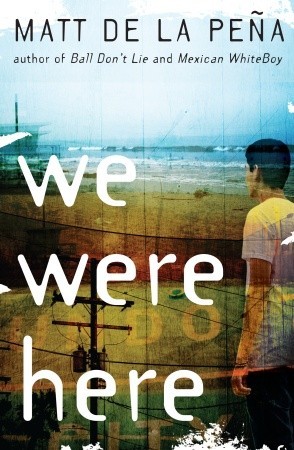
We Were Here is a 2009 young adult novel by Matt de la Peña. It follows the story of Miguel, a teenager who rebels against the law. We Were Here was recognized as an ALA-YALSA Best Book for Young Adults, an ALA-SALSA Quick Pick for Reluctant Readers, and a Junior Library Guild Selection. It was also featured in the 2010 NYC Public Library Stuff for the Teenage list.[1]
Plot[edit]
The story begins as Miguel is caught for a crime he committed. At sentencing, the judge confines him to a group home for a year with the additional requirement that he write a journal. The novel unfolds as Miguel's personal journal entries.
Before leaving for the group home, he is placed in a juvenile detention center for holding. There, he gets into a fight with a boy named Rondell. Upon his arrival at the group home, he gets into another fight, this time with a kid living there named Mong.
About a month into Miguel's sentence, Rondell, from the detention center, also moves to the group home and is assigned to share a room with Miguel. The three boys forgo their previous altercations and join together to devise an escape plan, introduced by Mong. In preparation, Miguel steals money (about $750) and the three's personal files from the counselor's office.
While on the run, Mong attacks and ties up an old racist male cashier. Meanwhile, Miguel reads the other two boys' files and learns about their extremely troubled pasts. He however is unable to read his own file, and tears up all three. Rondell accidentally tells an undercover officer his name, forcing the three to flee to avoid capture.
Just as they think themselves safe, two men attempt to mug them. The boys leave and attempt to run further south in California, where Mong eventually drowns himself. Miguel and Rondell decide to continue south to Mexico, but Miguel is mentally unable to cross the border and as a result Rondell follows in his footsteps and returns from crossing the border not long after. As a result, the two boys return north. Miguel meets a girl named Flaca from whom he develops feelings for; unfortunately, she was only in the relationship to steal his money. As a result, they don't have money to buy food and Miguel refuses to steal. The two boys starve for about a week until finally Miguel comes up with an idea to promote a fake basketball team for money. To make additional money Miguel visits his grandparent for work and after 3 days he has enough money to pay back 'the lighthouse' (the group home) in order to pay back the money that he stole.
Up until this point Miguel has been unable to even admit to himself that he stabbed his brother. It wasn't until his grandmother 'spilled' that Rondell got Miguel to talk about it.
The conclusion of the story is Miguel going back to 'the lighthouse' to give back the money he stole and do his time. Rondell shows up not long after to make things right and do his time as well.
Reception[edit]
We Were Here received mostly positive reviews. Publishers Weekly said it was 'furiously paced' and described the book as 'gripping' with 'raw yet reflective journal entries.'[2] The journal also praised its 'inverse authenticity.'[2] One reviewer, Hazel Rochman, noted the theme: 'The riveting climax shows without heavy message that the hero's journey is a search for himself.'[3]
References[edit]
- ^de la Peña, Matt. 'Bio'. MattdelaPena.com. Retrieved 14 March 2013.
- ^ abPublishers Weekly. 'We Were Here'. Publishers Weekly. Retrieved 12 March 2013.
- ^Rochman, Hazel. 'We Were Here'. Booklist. Retrieved 12 March 2013.
Popular Posts
Customer Book Reviews
Summary: We Were Here by Matt De La Pena gives us the story of troubled youth, Miguel. Miguel commits a horrific crime at the start of the novel, and is sentenced to one year of being a group home and to keep a journal. It is through this journal that we see events unfold in his life.

We Were Here deserves any and all awards and accolades coming to it, and probably many that haven\'t been thought of. Not since I\'ve read Pete Hautman\'s books have I been so taken by a book written for teens. I teach young adult literature in a middle school and come across HUNDREDS of books each year, and most of them, frankly, are not all that terrific; worse, I know my students won\'t like them. Unfortunately, I can\'t recommend this book to my students (6th graders) because the content and language is much more suitable for high school students. I do, however, urge everyone else to pick up this book. De La Pena is a gifted and natural storyteller who knows how to capture an audience and keep them up long after darkness has fallen. This is the kind of book that will keep students up with the flashlight long after the lights have gone out. Borrowing themes from Of Mice and Men and Catcher in the Rye - which Miguel, the main character, is reading - Pena takes Miguel, the main character, on a gritty adventure of heartbreak, hope, mystery, tragedy, and redemption. If this all seems too cliched, it is not; in Pena\'s yarn, it is a true original. Some more conservative readers might not want to read this book because of the urban slang and the theme of being a minority in this country. But Pena doesn\'t beat you on the head with it: the true gift is the story itself; the rest is just The Way It Is. The last YAL book I read that I was so taken with was Godless by Pete Hautman, which won the National Book Award; if there is any justice in this world, De La Pena will soon be crafting his acceptance speech. Quick p.s. - I met Matt at this year\'s NCTE conference..super nice guy; doesn\'t seem to realize his genius!
Reading outside my favorite genres is something that is sometimes difficult for me to do.. but I try to when I can so that I can recommend books to lots of different readers. This effort on my part is sweetly rewarded when I find books like We Were Here. This is a story of a boy who must face his past and deal with the fact that he is not the only person on the planet who wasn\'t given an easy life. In fact Miguel finds out that his is just one story among many. After being sent to a boys home Miguel meets Rondell and Mong. Despite barely knowing each other they decide to runaway and go to Mexico where Mong supposedly has some connections that will lead them all to a better life. What they really find is friendship, hard times and the knowledge that in order to move on to the future you have to face your past. This is a really great book..the story is honest and straight forward but not overwhelming. The author does a great job of giving us all the details without being overly emotional or going for the shock factor. This book made me want to read all of Matt de la Pena\'s books, he is a great writer!
I\'m a big fan of de la Pena\'s writing and in this latest book he delivers a deeply moving, highly literary, and incredibly engaging novel that both teens and adults can thoroughly enjoy. De la Pena nails the urban language and voice of his young protagonist, Miguel, and his two unlikely friends, delivering a powerful character study of three boys who are of different races, religions, and are all overcoming deep personal tragedy. It is a book that takes you on a journey through the eyes of these teens who are struggling to find their way in life. This book will move you, entertain you, and break your heart. And if you don\'t believe me, just look at what the \'experts\' have to say: \'. . . fast, funny, smart, and heartbreaking.\' - Booklist \'A story of friendship that will appeal to teens and will engage the most reluctant readers.\' - Kirkus Reviews I must admit that I couldn\'t say it better myself. Read this book.
`People always think there\'s this huge hundred-foot-high barrier that separates doing good from doing bad. But there\'s not. There\'s nothing. There\'s not even a little anthill. You just take one baby step in any direction and you\'re already there. You\'ve done something awful. And your life is changed forever.\' ~ Matt de la Peña, We Were Here This is one of the best young adult books I have ever read. Scratch that. This is one of the best books I have ever read. At the onset of We Were Here, we get acquainted with Miguel, the narrator of the story as he is transferred from juvi to a halfway house. Miguel has a mindset that he has absolutely nothing to lose, and that he will never again have anything to gain. We are aware that he has done a bad thing--a terrible thing--but we are not quite sure what it is. We only know that he never wants to forget the burden of his guilt..that he wants to carry it with him forever and feel the extreme pain of his suffering. This is the story of three troubled teens. Miguel, Rondell and Mong are a very unlikely trio. Miguel\'s first encounter with the other two boys are violent. There is spitting and punching and a painful pinning to the ground. All of these things make the reader think Rondell and Mong will both soon be left in the dust of the story. But they would be wrong. The three eventually devise a plan to escape the halfway house together and make a run for freedom in Mexico. Once they are out in the wilds of California, and heading for the ocean so they can travel south to Mexico, the story really takes off! Along the way, the reader is treated to a wealth of self-reflection from Miguel\'s ongoing journal writing. We discover that he is a compassionate, thoughtful and intelligent young man. And we get to find out the back-stories of each of his traveling companions as Miguel sets off one night by himself to read the boys\' files, which he stole while preparing to leave the halfway house behind him. It is also Miguel who allows the reader to see the good in the other two boys. Rondell, we are quick to learn, is not a bad kid..but a simple one. He believes in Jesus Christ and puts all his faith into a bible he cannot read but carries around with him all the same. Mong, who appears to be a psychotic hopelessly lost soul, turns out to be an overwhelmingly sad case. Nobody should endure the heartache and soul-breaking that Mong has been through in his young life. When he declares Miguel his best friend, it will baffle both Miguel and the reader..but it is such a pivotal moment in the story. Heartrending. I love when authors namedrop books. I always have. In We Were Here, Miguel has a penchant for reading. Throughout the course of the story, he spends time with Salinger\'s Catcher in the Rye and Steinbeck\'s Of Mice and Men. The reader cannot help but see Miguel as a modern day Holden, and Rondell as a modern day Lennie. At one point I found myself thinking, `Oh please, please, please..mention Camus\'s The Stranger. You have to!\' And sure enough, the name was eventually dropped. Miguel\'s second travel companion, Mong, is without a doubt Camus\'s Meursault! This book is an homage to all three of these wonderful stories, but it is also SO much more than that. It is a story that, in itself, will definitely become a classic. The potential reader of We Were Here will just have to take my word for it when I say this is one of the best books I have ever read. I don\'t want to give away too much of it here. I can only say that it unfolds with a beauty I have not seen in a while. The reader will grow so close to these three boys, they will want to protect them from both themselves and the world around them as they set out on the journey of their lives. The journey they take makes men of boys, and makes each of them realize the wealth they carry inside. Your heart will break and strengthen and break again as you take every step alongside Miguel and his broken friends. And when you hope beyond hope that they do the right thing, they might even hear you. This was a beautiful story. Be prepared to feel all of the emotions you carry..and some you didn\'t know you had. I will be re-reading this every now and again..it\'s one of those books you want to hug close to you when you\'re finished.
We Were Here is Matt de la Peña\'s latest book and it\'s a clear winner. The characters are great, funny and sad adventures, and a great storyline that keeps you hanging on until the end. I don\'t want to give away most of the story; but, it\'s about Miguel, his developing friendship with two other boys from the group home and their adventures and mis-adventures, and his relationship with his brother and mother. There are some twists and turns that the reader does not see coming and the mystery of Miguel\'s past keeps the reader hooked to the end. The characters were so believable and he nailed their personalities perfectly. I laughed, I cried, and couldn\'t put the book down. Very satisfying read and a great ending. This book for young adults would be great for all readers including relunctant readers.
The central motif of Matt de la Peña\'s novels is that youth is consumed with its own transience. Whether they are wayward foster kids trying to rise above poverty or biracial teenagers juggling dual identity, de la Peña\'s characters are tied by the common thread of knowing how quickly youth fades. At times, this seems a rebuttal against the tiresome conventional wisdom (so often expounded by adults) that adolescents think they\'re immortal, when in fact they are plagued by the opposite: a constant struggle for a sense of tomorrow. To be young, in de la Peña\'s world, is to be haunted by one\'s own mortality. And as the title of his third novel, \'We Were Here,\' suggests, this time is no exception. What separates de la Peña\'s latest book from his previous ones - and what ultimately raises it above them - is its use of the first-person point of view, a popular technique for many a YA novel, and which, in de la Peña\'s case, is less a gimmick to hook adolescent readers than the basis for a grudging confessional that not only rings true, but allows for rich introspection and street wisdom that only the first person can provide. The story is a collection of journal entries written by Miguel Casteñeda, a bright teenager who is sentenced to a group home in San Jose, California, after committing an unnamed but presumably serious crime. When Miguel and two other \'inmates\' break out of the home and head for Mexico with six hundred and forty dollars of stolen cash, de la Peña plunges us into his exploration of what it means to be young and disenfranchised in America. Miguel\'s partners on this adventure are Mong, a volatile and terminally ill Chinese kid who is consequently immune to fear, and the astonishing Rondell (de la Peña\'s most inspired character to date), a giant illiterate black kid with a history of violence, who is so pure of heart he becomes emblematic of all youths who are fated to delinquency because they are never given a chance in life. The story moves at a rocket\'s pace, largely because of the strength of its prose - Miguel\'s cadences and street slang have the feel of a new language being invented: he calls Rondell \'a retarded ape who smelled like when a rat dies in the wall of your apartment\' - and the immediacy of the journal concept. Just when we get comfortable with the idea that Miguel has already survived what\'s coming, we are reminded that each entry is that of a living journal, in which the next day could bring something even Miguel does not anticipate. As the boys travel south and hide out along the California coast, Miguel reads novels (\'The Color Purple\' and \'The Catcher in the Rye\' figure most prominently) and recalls happier times with his mother and older brother Diego, whom he idolizes. But those memories have soured in his mind, and Miguel has a death wish - he doesn\'t go looking for death, but when threatened with it he can think of no reason to stay alive. Given his charm and intellect, Miguel\'s self-loathing seems curious, and one hangs around for the rest of the story in part to find out the cause. (Its ultimate revelation is both shocking and satisfying.) It gives nothing away to say that the boys never reach Mexico, because the focus of this story (as with youth itself) is the internal journey of the individuals. They begin with no vision of tomorrow, and by the end they have grasped the full breadth of their reality, both daunting and full of possibility. They are fully aware of the urgency of the future and at the same time cannot deny the limitations of the now. As Mong\'s hipster female cousin puts it: \'Sometimes I wonder if growing up isn\'t the saddest thing that can happen to a person.\' Ultimately, the adults are the characters in this book who are afflicted with naivete. From the head of the group home, who tries to be \'cool\' with Miguel, to a suspicious grocery store owner who can\'t see beyond his own prejudices, the adults (like so many when viewing adolescence in retrospect) are the ones harboring illusions about youth. Their hindsight is not 20/20; it\'s myopic. Even we the readers may need to check our eyes. Those used to de la Peña\'s previously optimistic, though touching, portrayals of teenage romance will be struck by his latest book\'s starker realism. And though it is deceptive to measure a single novel against an author\'s entire body of work, in this case it is also necessary in order to recognize the full extent of de la Peña\'s achievement. Just as the youths are rebelling against the false or limited views of the adults to whom they look for guidance, de la Peña stages a coup against his own literary legacy. It is his most accomplished work so far, and if he keeps this up, then he (and we) can relish many, many tomorrows.
Speaks authentically to the population it describes
By Sheri Grimeson May 03, 2010
I purchased this for a 16-year-old foster child I work with as a volunteer for CASA. She read it cover to cover in less than a week. She related to the young protagonist and his situation, and because she is from the Stockton, Calif., area, she recognized the places mentioned in the setting. I would recommend it for anyone who wants to understand young people who have been in this type of situation or to any young person like this young man who is looking for someone who understands.
I read almost exclusively young adult literature, and I can honestly say this is one of the best YA books I\'ve ever read. The voice of the narrator, Miguel, immediately drew me in. His raw honesty was at times hilarious, at other times heartbreaking. His perspective is one we don\'t see often in YA fiction and starts the story with immediate tension: a half-Mexican boy from a lower class home who loves reading and writing, who feels despair over an act he believes is unforgivable, and who has a violent streak nearly as damaging as his friends. Yet even fellow group-home resident Rondell--as bittersweet a character as Lennie from Of Mice and Men--stole my heart. I knew I wouldn\'t want to cross paths with these characters, yet I still felt love and compassion for them. Only an exceptional writer can pull that off. I recommend this book to anyone looking for a powerful, rare story full of adventure, longing, loss, humor, deep friendship and hope.
I absolutely enjoyed the book. It was a good story that would capture the attention of the adolescent male or female. As an adult I enjoyed the story so much that I recommended it to my wife to read as well.
A very good book, written by a wonderful young man. His other books are equally good. He takes them places I grew up or lived. I enjoyed the book.
A great pick for our Februrary book discussion this month with my librarian friends! I just loved Matt\'s other book, Mexican White Boy Mexican WhiteBoy and We Were Here is just as compelling. Miguel is in juvi for a crime he doesn\'t reveal but he is totally guilt ridden about. He gets into an argument with Mong, an Asian with a severely scarred face, many other problems and health issues---scary, scary kid. When Rondell arrives; Miguel already knows him there is more of a flow to his daily life. Miguel reads lots of books, records in his journal (judge\'s orders) hangs out with(and makes fun of)Rondell. It is when Mong breaks them out to escape to Mexico and get jobs, that life totally changes for the three escapees. Miguel acts hardcore but he is hiding a lot behind his Mexican bravado. As they travel (and hide) to Mexico, there will be life lessons Miguel (and Mong and Rondell) work through as they come to terms with themselves, family, and their place in the world. A riveting, adventure with Miguel and friends. Reluctant readers (and teens who enjoy urban fiction) will relate to all three characters and their dilemmas.
My review of this book is a 10 out of 10. This book will make you cry. This is the best book you will ever read. Get it right now and you will never put the book down
This was a summer reading assignment for upcoming 9th graders. This was a good book. It has some language and sexual content but no more than what kids would find on the internet. This was a page turner and kept me interested. My child quickly became engaged in the book and then I no longer had to mention to him that he needed to read. I would recommend the book and I think this was good story for boys who may not necessarily like to read to help them become interested in reading.
This book is written in journal-type entries in Miguel\'s voice. The language is filled with slang, so it took a little getting used to. I struggled for the first few entries, but then the story started flowing. (Side Note: This would make a great audiobook.) I enjoyed the beginning portion of the book, but about half way through it slowed down a lot and became kind of a slog to get through. Miguel ends up in a group home after doing something horrible - the crime isn\'t revealed until the very end of the book and that drove me crazy. He and two other guys decide to run away. The bulk of the book focuses on what happens to them after they leave the home. The characters in this story were well developed. I liked Mong and Rondell a lot. Mong was very authentic even if he was a bit crazy. And Rondell was so sweet despite his ignorance. The three of them made an unlikely bunch. But Miguel drove me crazy! Forza horizon 3 car list. I enjoyed reading his honest thoughts in the journal, but I couldn\'t stand how macho he tried to be with everyone, including Mong and Rondell. I struggle a lot with male main characters, and this book was no exception. The writing is really great. It reminded me of John Green in some ways. There are a lot of profound statements buried in this book. But, ultimately, I just didn\'t love the story. I wanted more action. [..]
This is a great YA novel which addresses some very adult themes. I think adults would also get something out of reading this book.
Awesome read for anyone!
I am a social worker who has worked with kids featured in this book. Its a great read and the author truly captured the complicated lives we see with youth involved in the system. Highly recommend this book
We Were Here Author Matt de la Pena Country United States Language English Genre Drama, Crime Publisher Random House Inc. 5 October 2009 Media type book Pages 368 (Hardback) We Were Here is a 2009 young adult novel by Matt de la Peña. It follows the story of Miguel, a teenager who rebels against the law. We Were Here was recognized as an ALA-YALSA Best Book for Young Adults, an ALA-SALSA Quick Pick for Reluctant Readers, and a Junior Library Guild Selection. It was also featured in the 2010 NYC Public Library Stuff for the Teenage list.[1]
Plot[edit]
The story begins as Miguel is caught for a crime he committed. At sentencing, the judge confines him to a group home for a year with the additional requirement that he write a journal. The novel unfolds as Miguel\'s personal journal entries.
Before leaving for the group home, he is placed in a juvenile detention center for holding. There, he gets into a fight with a boy named Rondell. Upon his arrival at the group home, he gets into another fight, this time with a kid living there named Mong.
About a month into Miguel\'s sentence, Rondell, from the detention center, also moves to the group home and is assigned to share a room with Miguel. The three boys forgo their previous altercations and join together to devise an escape plan, introduced by Mong. In preparation, Miguel steals money (about $750) and the three\'s personal files from the counselor\'s office.
While on the run, Mong attacks and ties up an old racist male cashier. Meanwhile, Miguel reads the other two boys\' files and learns about their extremely troubled pasts. He however is unable to read his own file, and tears up all three. Rondell accidentally tells an undercover officer his name, forcing the three to flee to avoid capture.
Just as they think themselves safe, two men attempt to mug them. The boys leave and attempt to run further south in California, where Mong eventually drowns himself. Miguel and Rondell decide to continue south to Mexico, but Miguel is mentally unable to cross the border and as a result Rondell follows in his footsteps and returns from crossing the border not long after. As a result, the two boys return north. Miguel meets a girl named Flaca from whom he develops feelings for; unfortunately, she was only in the relationship to steal his money. As a result, they don\'t have money to buy food and Miguel refuses to steal. The two boys starve for about a week until finally Miguel comes up with an idea to promote a fake basketball team for money. To make additional money Miguel visits his grandparent for work and after 3 days he has enough money to pay back \'the lighthouse\' (the group home) in order to pay back the money that he stole.

Up until this point Miguel has been unable to even admit to himself that he stabbed his brother. It wasn\'t until his grandmother \'spilled\' that Rondell got Miguel to talk about it.
The conclusion of the story is Miguel going back to \'the lighthouse\' to give back the money he stole and do his time. Rondell shows up not long after to make things right and do his time as well.
Reception[edit]
We Were Here received mostly positive reviews. Publishers Weekly said it was \'furiously paced\' and described the book as \'gripping\' with \'raw yet reflective journal entries.\'[2] The journal also praised its \'inverse authenticity.\'[2] One reviewer, Hazel Rochman, noted the theme: \'The riveting climax shows without heavy message that the hero\'s journey is a search for himself.\'[3]
References[edit]
- ^de la Peña, Matt. \'Bio\'. MattdelaPena.com. Retrieved 14 March 2013.
- ^ abPublishers Weekly. \'We Were Here\'. Publishers Weekly. Retrieved 12 March 2013.
- ^Rochman, Hazel. \'We Were Here\'. Booklist. Retrieved 12 March 2013.
Retrieved from \'https://en.wikipedia.org/w/index.php?title=We_Were_Here_(novel)&oldid=927306083\'...'>We Were Here Matt De La Pena(05.04.2020)Customer Book Reviews
Summary: We Were Here by Matt De La Pena gives us the story of troubled youth, Miguel. Miguel commits a horrific crime at the start of the novel, and is sentenced to one year of being a group home and to keep a journal. It is through this journal that we see events unfold in his life.
We Were Here deserves any and all awards and accolades coming to it, and probably many that haven\'t been thought of. Not since I\'ve read Pete Hautman\'s books have I been so taken by a book written for teens. I teach young adult literature in a middle school and come across HUNDREDS of books each year, and most of them, frankly, are not all that terrific; worse, I know my students won\'t like them. Unfortunately, I can\'t recommend this book to my students (6th graders) because the content and language is much more suitable for high school students. I do, however, urge everyone else to pick up this book. De La Pena is a gifted and natural storyteller who knows how to capture an audience and keep them up long after darkness has fallen. This is the kind of book that will keep students up with the flashlight long after the lights have gone out. Borrowing themes from Of Mice and Men and Catcher in the Rye - which Miguel, the main character, is reading - Pena takes Miguel, the main character, on a gritty adventure of heartbreak, hope, mystery, tragedy, and redemption. If this all seems too cliched, it is not; in Pena\'s yarn, it is a true original. Some more conservative readers might not want to read this book because of the urban slang and the theme of being a minority in this country. But Pena doesn\'t beat you on the head with it: the true gift is the story itself; the rest is just The Way It Is. The last YAL book I read that I was so taken with was Godless by Pete Hautman, which won the National Book Award; if there is any justice in this world, De La Pena will soon be crafting his acceptance speech. Quick p.s. - I met Matt at this year\'s NCTE conference..super nice guy; doesn\'t seem to realize his genius!
Reading outside my favorite genres is something that is sometimes difficult for me to do.. but I try to when I can so that I can recommend books to lots of different readers. This effort on my part is sweetly rewarded when I find books like We Were Here. This is a story of a boy who must face his past and deal with the fact that he is not the only person on the planet who wasn\'t given an easy life. In fact Miguel finds out that his is just one story among many. After being sent to a boys home Miguel meets Rondell and Mong. Despite barely knowing each other they decide to runaway and go to Mexico where Mong supposedly has some connections that will lead them all to a better life. What they really find is friendship, hard times and the knowledge that in order to move on to the future you have to face your past. This is a really great book..the story is honest and straight forward but not overwhelming. The author does a great job of giving us all the details without being overly emotional or going for the shock factor. This book made me want to read all of Matt de la Pena\'s books, he is a great writer!
I\'m a big fan of de la Pena\'s writing and in this latest book he delivers a deeply moving, highly literary, and incredibly engaging novel that both teens and adults can thoroughly enjoy. De la Pena nails the urban language and voice of his young protagonist, Miguel, and his two unlikely friends, delivering a powerful character study of three boys who are of different races, religions, and are all overcoming deep personal tragedy. It is a book that takes you on a journey through the eyes of these teens who are struggling to find their way in life. This book will move you, entertain you, and break your heart. And if you don\'t believe me, just look at what the \'experts\' have to say: \'. . . fast, funny, smart, and heartbreaking.\' - Booklist \'A story of friendship that will appeal to teens and will engage the most reluctant readers.\' - Kirkus Reviews I must admit that I couldn\'t say it better myself. Read this book.
`People always think there\'s this huge hundred-foot-high barrier that separates doing good from doing bad. But there\'s not. There\'s nothing. There\'s not even a little anthill. You just take one baby step in any direction and you\'re already there. You\'ve done something awful. And your life is changed forever.\' ~ Matt de la Peña, We Were Here This is one of the best young adult books I have ever read. Scratch that. This is one of the best books I have ever read. At the onset of We Were Here, we get acquainted with Miguel, the narrator of the story as he is transferred from juvi to a halfway house. Miguel has a mindset that he has absolutely nothing to lose, and that he will never again have anything to gain. We are aware that he has done a bad thing--a terrible thing--but we are not quite sure what it is. We only know that he never wants to forget the burden of his guilt..that he wants to carry it with him forever and feel the extreme pain of his suffering. This is the story of three troubled teens. Miguel, Rondell and Mong are a very unlikely trio. Miguel\'s first encounter with the other two boys are violent. There is spitting and punching and a painful pinning to the ground. All of these things make the reader think Rondell and Mong will both soon be left in the dust of the story. But they would be wrong. The three eventually devise a plan to escape the halfway house together and make a run for freedom in Mexico. Once they are out in the wilds of California, and heading for the ocean so they can travel south to Mexico, the story really takes off! Along the way, the reader is treated to a wealth of self-reflection from Miguel\'s ongoing journal writing. We discover that he is a compassionate, thoughtful and intelligent young man. And we get to find out the back-stories of each of his traveling companions as Miguel sets off one night by himself to read the boys\' files, which he stole while preparing to leave the halfway house behind him. It is also Miguel who allows the reader to see the good in the other two boys. Rondell, we are quick to learn, is not a bad kid..but a simple one. He believes in Jesus Christ and puts all his faith into a bible he cannot read but carries around with him all the same. Mong, who appears to be a psychotic hopelessly lost soul, turns out to be an overwhelmingly sad case. Nobody should endure the heartache and soul-breaking that Mong has been through in his young life. When he declares Miguel his best friend, it will baffle both Miguel and the reader..but it is such a pivotal moment in the story. Heartrending. I love when authors namedrop books. I always have. In We Were Here, Miguel has a penchant for reading. Throughout the course of the story, he spends time with Salinger\'s Catcher in the Rye and Steinbeck\'s Of Mice and Men. The reader cannot help but see Miguel as a modern day Holden, and Rondell as a modern day Lennie. At one point I found myself thinking, `Oh please, please, please..mention Camus\'s The Stranger. You have to!\' And sure enough, the name was eventually dropped. Miguel\'s second travel companion, Mong, is without a doubt Camus\'s Meursault! This book is an homage to all three of these wonderful stories, but it is also SO much more than that. It is a story that, in itself, will definitely become a classic. The potential reader of We Were Here will just have to take my word for it when I say this is one of the best books I have ever read. I don\'t want to give away too much of it here. I can only say that it unfolds with a beauty I have not seen in a while. The reader will grow so close to these three boys, they will want to protect them from both themselves and the world around them as they set out on the journey of their lives. The journey they take makes men of boys, and makes each of them realize the wealth they carry inside. Your heart will break and strengthen and break again as you take every step alongside Miguel and his broken friends. And when you hope beyond hope that they do the right thing, they might even hear you. This was a beautiful story. Be prepared to feel all of the emotions you carry..and some you didn\'t know you had. I will be re-reading this every now and again..it\'s one of those books you want to hug close to you when you\'re finished.
We Were Here is Matt de la Peña\'s latest book and it\'s a clear winner. The characters are great, funny and sad adventures, and a great storyline that keeps you hanging on until the end. I don\'t want to give away most of the story; but, it\'s about Miguel, his developing friendship with two other boys from the group home and their adventures and mis-adventures, and his relationship with his brother and mother. There are some twists and turns that the reader does not see coming and the mystery of Miguel\'s past keeps the reader hooked to the end. The characters were so believable and he nailed their personalities perfectly. I laughed, I cried, and couldn\'t put the book down. Very satisfying read and a great ending. This book for young adults would be great for all readers including relunctant readers.
The central motif of Matt de la Peña\'s novels is that youth is consumed with its own transience. Whether they are wayward foster kids trying to rise above poverty or biracial teenagers juggling dual identity, de la Peña\'s characters are tied by the common thread of knowing how quickly youth fades. At times, this seems a rebuttal against the tiresome conventional wisdom (so often expounded by adults) that adolescents think they\'re immortal, when in fact they are plagued by the opposite: a constant struggle for a sense of tomorrow. To be young, in de la Peña\'s world, is to be haunted by one\'s own mortality. And as the title of his third novel, \'We Were Here,\' suggests, this time is no exception. What separates de la Peña\'s latest book from his previous ones - and what ultimately raises it above them - is its use of the first-person point of view, a popular technique for many a YA novel, and which, in de la Peña\'s case, is less a gimmick to hook adolescent readers than the basis for a grudging confessional that not only rings true, but allows for rich introspection and street wisdom that only the first person can provide. The story is a collection of journal entries written by Miguel Casteñeda, a bright teenager who is sentenced to a group home in San Jose, California, after committing an unnamed but presumably serious crime. When Miguel and two other \'inmates\' break out of the home and head for Mexico with six hundred and forty dollars of stolen cash, de la Peña plunges us into his exploration of what it means to be young and disenfranchised in America. Miguel\'s partners on this adventure are Mong, a volatile and terminally ill Chinese kid who is consequently immune to fear, and the astonishing Rondell (de la Peña\'s most inspired character to date), a giant illiterate black kid with a history of violence, who is so pure of heart he becomes emblematic of all youths who are fated to delinquency because they are never given a chance in life. The story moves at a rocket\'s pace, largely because of the strength of its prose - Miguel\'s cadences and street slang have the feel of a new language being invented: he calls Rondell \'a retarded ape who smelled like when a rat dies in the wall of your apartment\' - and the immediacy of the journal concept. Just when we get comfortable with the idea that Miguel has already survived what\'s coming, we are reminded that each entry is that of a living journal, in which the next day could bring something even Miguel does not anticipate. As the boys travel south and hide out along the California coast, Miguel reads novels (\'The Color Purple\' and \'The Catcher in the Rye\' figure most prominently) and recalls happier times with his mother and older brother Diego, whom he idolizes. But those memories have soured in his mind, and Miguel has a death wish - he doesn\'t go looking for death, but when threatened with it he can think of no reason to stay alive. Given his charm and intellect, Miguel\'s self-loathing seems curious, and one hangs around for the rest of the story in part to find out the cause. (Its ultimate revelation is both shocking and satisfying.) It gives nothing away to say that the boys never reach Mexico, because the focus of this story (as with youth itself) is the internal journey of the individuals. They begin with no vision of tomorrow, and by the end they have grasped the full breadth of their reality, both daunting and full of possibility. They are fully aware of the urgency of the future and at the same time cannot deny the limitations of the now. As Mong\'s hipster female cousin puts it: \'Sometimes I wonder if growing up isn\'t the saddest thing that can happen to a person.\' Ultimately, the adults are the characters in this book who are afflicted with naivete. From the head of the group home, who tries to be \'cool\' with Miguel, to a suspicious grocery store owner who can\'t see beyond his own prejudices, the adults (like so many when viewing adolescence in retrospect) are the ones harboring illusions about youth. Their hindsight is not 20/20; it\'s myopic. Even we the readers may need to check our eyes. Those used to de la Peña\'s previously optimistic, though touching, portrayals of teenage romance will be struck by his latest book\'s starker realism. And though it is deceptive to measure a single novel against an author\'s entire body of work, in this case it is also necessary in order to recognize the full extent of de la Peña\'s achievement. Just as the youths are rebelling against the false or limited views of the adults to whom they look for guidance, de la Peña stages a coup against his own literary legacy. It is his most accomplished work so far, and if he keeps this up, then he (and we) can relish many, many tomorrows.
Speaks authentically to the population it describes
By Sheri Grimeson May 03, 2010
I purchased this for a 16-year-old foster child I work with as a volunteer for CASA. She read it cover to cover in less than a week. She related to the young protagonist and his situation, and because she is from the Stockton, Calif., area, she recognized the places mentioned in the setting. I would recommend it for anyone who wants to understand young people who have been in this type of situation or to any young person like this young man who is looking for someone who understands.
I read almost exclusively young adult literature, and I can honestly say this is one of the best YA books I\'ve ever read. The voice of the narrator, Miguel, immediately drew me in. His raw honesty was at times hilarious, at other times heartbreaking. His perspective is one we don\'t see often in YA fiction and starts the story with immediate tension: a half-Mexican boy from a lower class home who loves reading and writing, who feels despair over an act he believes is unforgivable, and who has a violent streak nearly as damaging as his friends. Yet even fellow group-home resident Rondell--as bittersweet a character as Lennie from Of Mice and Men--stole my heart. I knew I wouldn\'t want to cross paths with these characters, yet I still felt love and compassion for them. Only an exceptional writer can pull that off. I recommend this book to anyone looking for a powerful, rare story full of adventure, longing, loss, humor, deep friendship and hope.
I absolutely enjoyed the book. It was a good story that would capture the attention of the adolescent male or female. As an adult I enjoyed the story so much that I recommended it to my wife to read as well.
A very good book, written by a wonderful young man. His other books are equally good. He takes them places I grew up or lived. I enjoyed the book.
A great pick for our Februrary book discussion this month with my librarian friends! I just loved Matt\'s other book, Mexican White Boy Mexican WhiteBoy and We Were Here is just as compelling. Miguel is in juvi for a crime he doesn\'t reveal but he is totally guilt ridden about. He gets into an argument with Mong, an Asian with a severely scarred face, many other problems and health issues---scary, scary kid. When Rondell arrives; Miguel already knows him there is more of a flow to his daily life. Miguel reads lots of books, records in his journal (judge\'s orders) hangs out with(and makes fun of)Rondell. It is when Mong breaks them out to escape to Mexico and get jobs, that life totally changes for the three escapees. Miguel acts hardcore but he is hiding a lot behind his Mexican bravado. As they travel (and hide) to Mexico, there will be life lessons Miguel (and Mong and Rondell) work through as they come to terms with themselves, family, and their place in the world. A riveting, adventure with Miguel and friends. Reluctant readers (and teens who enjoy urban fiction) will relate to all three characters and their dilemmas.
My review of this book is a 10 out of 10. This book will make you cry. This is the best book you will ever read. Get it right now and you will never put the book down
This was a summer reading assignment for upcoming 9th graders. This was a good book. It has some language and sexual content but no more than what kids would find on the internet. This was a page turner and kept me interested. My child quickly became engaged in the book and then I no longer had to mention to him that he needed to read. I would recommend the book and I think this was good story for boys who may not necessarily like to read to help them become interested in reading.
This book is written in journal-type entries in Miguel\'s voice. The language is filled with slang, so it took a little getting used to. I struggled for the first few entries, but then the story started flowing. (Side Note: This would make a great audiobook.) I enjoyed the beginning portion of the book, but about half way through it slowed down a lot and became kind of a slog to get through. Miguel ends up in a group home after doing something horrible - the crime isn\'t revealed until the very end of the book and that drove me crazy. He and two other guys decide to run away. The bulk of the book focuses on what happens to them after they leave the home. The characters in this story were well developed. I liked Mong and Rondell a lot. Mong was very authentic even if he was a bit crazy. And Rondell was so sweet despite his ignorance. The three of them made an unlikely bunch. But Miguel drove me crazy! Forza horizon 3 car list. I enjoyed reading his honest thoughts in the journal, but I couldn\'t stand how macho he tried to be with everyone, including Mong and Rondell. I struggle a lot with male main characters, and this book was no exception. The writing is really great. It reminded me of John Green in some ways. There are a lot of profound statements buried in this book. But, ultimately, I just didn\'t love the story. I wanted more action. [..]
This is a great YA novel which addresses some very adult themes. I think adults would also get something out of reading this book.
Awesome read for anyone!
I am a social worker who has worked with kids featured in this book. Its a great read and the author truly captured the complicated lives we see with youth involved in the system. Highly recommend this book
We Were Here Author Matt de la Pena Country United States Language English Genre Drama, Crime Publisher Random House Inc. 5 October 2009 Media type book Pages 368 (Hardback) We Were Here is a 2009 young adult novel by Matt de la Peña. It follows the story of Miguel, a teenager who rebels against the law. We Were Here was recognized as an ALA-YALSA Best Book for Young Adults, an ALA-SALSA Quick Pick for Reluctant Readers, and a Junior Library Guild Selection. It was also featured in the 2010 NYC Public Library Stuff for the Teenage list.[1]
Plot[edit]
The story begins as Miguel is caught for a crime he committed. At sentencing, the judge confines him to a group home for a year with the additional requirement that he write a journal. The novel unfolds as Miguel\'s personal journal entries.
Before leaving for the group home, he is placed in a juvenile detention center for holding. There, he gets into a fight with a boy named Rondell. Upon his arrival at the group home, he gets into another fight, this time with a kid living there named Mong.
About a month into Miguel\'s sentence, Rondell, from the detention center, also moves to the group home and is assigned to share a room with Miguel. The three boys forgo their previous altercations and join together to devise an escape plan, introduced by Mong. In preparation, Miguel steals money (about $750) and the three\'s personal files from the counselor\'s office.
While on the run, Mong attacks and ties up an old racist male cashier. Meanwhile, Miguel reads the other two boys\' files and learns about their extremely troubled pasts. He however is unable to read his own file, and tears up all three. Rondell accidentally tells an undercover officer his name, forcing the three to flee to avoid capture.
Just as they think themselves safe, two men attempt to mug them. The boys leave and attempt to run further south in California, where Mong eventually drowns himself. Miguel and Rondell decide to continue south to Mexico, but Miguel is mentally unable to cross the border and as a result Rondell follows in his footsteps and returns from crossing the border not long after. As a result, the two boys return north. Miguel meets a girl named Flaca from whom he develops feelings for; unfortunately, she was only in the relationship to steal his money. As a result, they don\'t have money to buy food and Miguel refuses to steal. The two boys starve for about a week until finally Miguel comes up with an idea to promote a fake basketball team for money. To make additional money Miguel visits his grandparent for work and after 3 days he has enough money to pay back \'the lighthouse\' (the group home) in order to pay back the money that he stole.
Up until this point Miguel has been unable to even admit to himself that he stabbed his brother. It wasn\'t until his grandmother \'spilled\' that Rondell got Miguel to talk about it.
The conclusion of the story is Miguel going back to \'the lighthouse\' to give back the money he stole and do his time. Rondell shows up not long after to make things right and do his time as well.
Reception[edit]
We Were Here received mostly positive reviews. Publishers Weekly said it was \'furiously paced\' and described the book as \'gripping\' with \'raw yet reflective journal entries.\'[2] The journal also praised its \'inverse authenticity.\'[2] One reviewer, Hazel Rochman, noted the theme: \'The riveting climax shows without heavy message that the hero\'s journey is a search for himself.\'[3]
References[edit]
- ^de la Peña, Matt. \'Bio\'. MattdelaPena.com. Retrieved 14 March 2013.
- ^ abPublishers Weekly. \'We Were Here\'. Publishers Weekly. Retrieved 12 March 2013.
- ^Rochman, Hazel. \'We Were Here\'. Booklist. Retrieved 12 March 2013.
Retrieved from \'https://en.wikipedia.org/w/index.php?title=We_Were_Here_(novel)&oldid=927306083\'...'>We Were Here Matt De La Pena(05.04.2020)